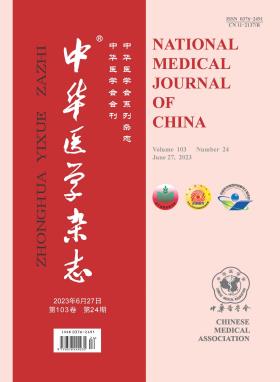
中华医学杂志
2023年 · 第103卷第24期
中华医学杂志
- 全部
- 述评
- 专家论坛
- 结构性心脏病
- 临床研究
- 短篇论著
- 病例报告
- 综述
- 文献速览
In children undergoing cardiac surgery, injection of nitric oxide into the airflow of an extracorporeal circulation oxygenator reduces the occurrence of postoperative low cardiac output syndrome, thereby promoting recovery and shortening invasive mechanical ventilation time. It is not clear whether injection of nitric oxide into an extracorporeal bypass oxygenator improves ventilator-free days (survival and no mechanical ventilation days). To clarify the effect of nitric oxide applied to an extracorporeal oxygenator and standard therapy on the number of days without mechanical ventilation in children undergoing congenital heart disease surgery, the study group conducted a double-blind, multicenter, randomized clinical trial in six pediatric cardiac surgery centers in Australia, New Zealand and the Netherlands. Between July 2017 and April 2021, a total of 1 371 children under 2 years of age who underwent surgery for congenital heart disease (7 children did not undergo cardiopulmonary bypass) were enrolled, and the last participant completed a 28-day follow-up on 24 May 2021. Children were randomly assigned to receive a concentration of 20×10-6Nitric oxide injection into an extracorporeal bypass oxygenator therapy (n=679) or standard cardiopulmonary bypass therapy without nitric oxide (n=685)。 The primary outcome was the number of days without mechanical ventilation from the start of cardiopulmonary bypass to Day 28. The four secondary outcomes were low cardiac output syndrome, extracorporeal life support or death, length of stay in intensive care unit, total length of stay, and postoperative troponin levels. A total of 1 371 children, aged (21.2±23.5) weeks, 587 (42.8%) were female and 1 364 (99.5%) completed the trial. The results showed no statistically significant difference in the number of days without mechanical ventilation between the nitric oxide group and the standard treatment group, with a median of 26.6 d (IQR: 24.4 to 27.4) and 26.4 d (IQR: 24.0 to 27.2), with an absolute difference of-0.01 d (95%CI:-0.25~0.22,P=0.92)。 22.5% and 20.9% of patients in the nitric oxide and standard treatment groups, respectively, developed low cardiac output syndrome or required extracorporeal life support within 48 h, or died within 28 d (adjustedOR=1.12,95%CI:0.85~1.47)。 There were no significant differences in other secondary outcomes between the two groups. The results of this study indicate that in children under 2 years of age who underwent cardiopulmonary bypass for congenital heart disease surgery, the use of cardiopulmonary nitric oxide has no significant effect on the number of days without mechanical ventilation. This finding does not support the application of nitric oxide to an extracorporeal circulation oxygenator in cardiac surgery.
The rapid development of virtual healthcare leads to a surge in the amount of information received by patients, accompanied by more workload and burnout of medical professionals. Artificial intelligence (AI) assistants may assist in drafting responses to patient questions, which are reviewed by clinicians. The study evaluated the ability of the AI Chatbot Assistant (ChatGPT), released in November 2022, to provide high-quality and empathetic answers to patients' questions. The study randomly selected 195 sessions in October 2022 from a database of questions from a public social media forum (Reddit'r/AskDocs) where an already certified physician answered patients'questions. While the chatbot answers were generated by entering the original question into the new conversation box on December 22 and 23, 2022. The original questions and anonymous and randomly sorted physician and chatbot responses were evaluated 3 times by a team of licensed medical professionals. Evaluators choose "whose response is better" and judge "quality of information provided" (very poor, poor, acceptable, good, or very good) and "empathy provided or attitude towards the patient" (no empathy, slightly empathy, moderately empathy, empathy, and very empathy) and compare the responses of the chatbot and the physician. 78.6% of 585 assessments (95%CI: 75.0% ~81.8%) of evaluators preferred the responses of chatbots. Average of physician responses (IQR) is significantly less than that of the chatbot [52 (17-62) than 211 (168-245) words,t=25.4,P<0.001]。 The quality of answers from chatbots was significantly higher than that of physicians (t=13.3,P<0.001)。 For example, the proportion of chatbots rated as good or very good in response quality was higher than that of physicians (chatbots: 78.5%, 95%CI:72.3%~84.1%; Physicians: 22.1%, 95%CI:16.4%~28.2%)。 This is equivalent to 3.6 times the proportion of chatbot answers that are good or very good than physicians. The chatbot's response was more empathetic than the physician's (t=18.9,P<0.001)。 The proportion of responses rated as empathetic or very empathetic was higher for chatbots than for physicians (chatbots: 45.1%, 95%CI:38.5%~51.8%; Physicians: 4.6%, 95%CI:2.1%~7.7%)。 This equates to 9.8 times the proportion of chatbots responding empathetically or very empathetically compared to physicians. In the study, the chatbots were high-quality and empathetic in response to questions about patients in online forums. It is necessary to further explore this technique in clinical work, such as using chatbots to draft drafts of responses, which are then edited and revised by physicians. Randomized trials can further evaluate whether the use of AI assistants can improve response, reduce clinician burnout for occupation, and improve patient prognosis.
Patent ductus arteriosus (PDA) in infants and young children is commonly treated with cyclooxygenase (COX) inhibitors, but the efficacy of such drugs is not clear. In this multicenter, non-inferiority trial, very premature infants (gestational age) with echocardiographic diagnosis of PDA (>1.5 mm diameter, left-to-right shunt<28 weeks) were randomly assigned to either expectant treatment or early ibuprofen treatment. Primary outcomes included necrotizing enterocolitis (Bell grade IIA and above), moderate to severe bronchopulmonary dysplasia, or death within 36 weeks of modified gestational age. Non-inferiority of expected treatment compared to early ibuprofen treatment was defined as unilateral 95%CIThe upper limit of<Absolute hazard margin of 10 percentage points. A total of 273 children were randomized with a median gestational age of 26 weeks and a median birth weight of 845 g. The primary outcome event occurred in 63 (46.3%) of 136 children in the expected treatment group and in 87 (63.5%) of 137 children in the early ibuprofen treatment group (difference in absolute risk = -17.2%, unilateral 95%CIUpper limit = -7.4%, non-inferiorityP<0.001)。 Necrotizing enterocolitis occurred in 24 of 136 children (17.6%) in the expected treatment group and in 21 of 137 children (15.3%) in the early ibuprofen treatment group (absolute risk difference =2.3%, bilateral 95%CI:-6.5%~11.1%)。 In the expectant treatment group, 117 patients were evaluated for bronchopulmonary dysplasia, and 39 patients (33.3%) were moderate to severe bronchopulmonary dysplasia; 112 children in the early ibuprofen treatment group were evaluated, and 57 (50.9%) were diagnosed with moderate to severe bronchopulmonary dysplasia (absolute risk difference = -17.6%, bilateral 95%CI:-30.2%~-5.0%)。 There were 19 (14.0%) deaths in the expected treatment group and 25 (18.2%) deaths in the early ibuprofen treatment group (absolute risk difference = -4.3%, bilateral 95%CI:-13.0%~4.4%)。 The incidence of other adverse events was similar in both groups. It is therefore concluded that expectant treatment of PDA in very premature infants shows no inferior effect to early ibuprofen treatment in reducing the incidence of necrotizing enterocolitis, bronchopulmonary dysplasia, or death within 36 weeks of corrected gestational age.
本期目次