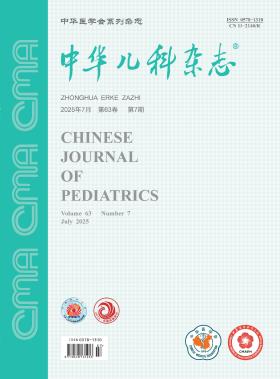
中华儿科杂志
2025年 · 第63卷第07期
中华儿科杂志
Since its establishment in 1915, the Chinese Medical Association has always been the core driving force for the development of Chinese medicine. As an authoritative academic journal of pediatrics sponsored by Chinese Medical Association, Chinese Journal of Pediatrics has promoted the inheritance and innovation of pediatric medicine in China with academics as a link since its inception in 1950. In the magnificent development of health undertakings, the Department of Pediatrics of Tongji Hospital Affiliated to Tongji Medical College of Huazhong University of Science and Technology (formerly Tongji Hospital Affiliated to Central South Tongji Medical College, later renamed the Second Affiliated Hospital of Wuhan Medical College and Tongji Hospital Affiliated to Tongji Medical University) has grown from scratch, from weak to strong, and its growth track is closely intertwined with the national destiny, and it is also inseparable from the academic support of Chinese Journal of Pediatrics. With the help of Chinese Journal of Pediatrics, the Department of Pediatrics of Tongji Hospital affiliated to Tongji Medical College of Huazhong University of Science and Technology has always resonated with Chinese Journal of Pediatrics, and jointly wrote a model chapter of the coordinated development of "clinical practice-academic research-discipline construction".
In the summer of 1950, shortly after the founding of New China, the Chinese Journal of Pediatrics was founded in Shanghai; Then in 1951, Zhejiang Children's Health Hospital was established in a narrow alley on the bank of West Lake. From then on, she and she are like a pair of good friends, supporting each other, nourishing each other and achieving each other. After seventy-five years of wind and rain, Chinese Journal of Pediatrics not only recorded the journey of pediatrics in China from toddler to climbing to the peak, but also witnessed pediatric research from germination to fruitful results, and became the authoritative academic exchange platform of pediatrics in China; Zhejiang Children's Health Hospital has also completed the transformation from an alley hospital to a high-quality, high-level and modern Children's Hospital affiliated to Zhejiang University School of Medicine, with more than 3,000 beds in four campuses. At the same time, it has become a national dual-center unit of the National Children's Health and Disease Clinical Medical Research Center and the National Children's Regional Medical Center, and its comprehensive strength ranks first among children's hospitals in China. If we want to use a metaphor to describe this journal and this children's hospital, then it is undoubtedly like two dazzling stars in the bright galaxy, illuminating the way forward of pediatric medicine in China with their own light.
In 1950, the Chinese Journal of Pediatrics was founded. In the past 75 years, China's economic culture and medical concepts have been constantly moving forward in the long river of history. In the process of continuous development, the Chinese Journal of Pediatrics adheres to the combination of theory and practice, focusing on practice; Combining basic and clinical, focusing on clinical; Combining popularization and improvement, emphasizing the purpose of running a journal. It is based on these that the content of each issue of Chinese Journal of Pediatrics takes into account clinical practicality, science and innovation, and becomes the second textbook for pediatricians, accompanied by the growth of every young pediatrician.
prescription sequence symmetry analysis (PSSA) is a research method based on a complete database of prescription records, which is used to mine adverse drug reaction signals. PSSA can be regarded as a simplified self-case series study, a single-case study design in which patients act as both an experimental group and a self-control, thus effectively controlling confounding factors such as age, sex, and medical behavior that do not change over time.
本期目次