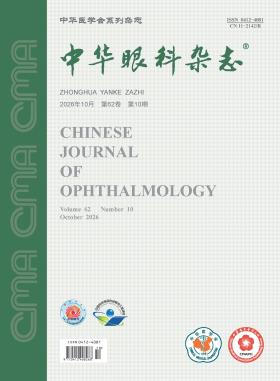
Chinese Journal of Ophthalmology

Chinese Journal of Ophthalmology is a professional academic journal of ophthalmology sponsored by the Chinese Medical Association. It was founded in 1950 and is intended mainly for the broad community of ophthalmologists. It reports leading scientific research achievements and clinical diagnosis and treatment experience in the field of ophthalmology, as well as basic theoretical research that provides guidance for ophthalmic clinical practice and is closely integrated with ophthalmic clinical practice. The aims of the journal are: to implement the Party and state policies and guidelines on health work, to implement the publishing policy of integrating theory with practice and combining popularization with improvement, to reflect major progress in ophthalmic clinical and scientific research in China, and to promote academic exchange in ophthalmology at home and abroad. At present, the journal is publicly published and distributed in China and abroad in a variety of media forms, and regularly exchanges journals with more than 30 countries and regions, including the United States and Japan. For many years, the journal's impact factor, total citation frequency, and other indicators have ranked among the top in domestic journals in this specialty. The papers published have been indexed by nearly 20 important databases at home and abroad, including the U.S. Index Medicus (IM/MEDLINE); important domestic information research institutions, libraries, medical colleges, and research units all list this journal as a core journal. The journal has successively won important awards from the former State Science and Technology Commission and the China Association for Science and Technology, has been awarded the title of "Demonstration Project of the China Association for Science and Technology Excellent Scientific and Technological Journal Project" for several consecutive years, is a journal in the cultivation plan of the Excellent Scientific and Technological Journal Project, and has been included among the 300 excellent journals of the Ministry of Science and Technology of China and the 100 Chinese Outstanding Academic Journals of the Institute of Scientific and Technical Information of China.
1 Main columns of the journal
The main permanent columns of the journal include expert editorials, focus forums, discussions on standards and norms, academic debates, original articles, research letters, technical exchange, case reports, clinical case discussions, ophthalmology management, surgical video presentations, image highlights, reviews, expert forums, Chinese ophthalmology history, academic trends, etc. Among them, manuscripts for expert editorials and expert forums are mainly solicited, while manuscripts for other columns are mainly unsolicited submissions.
2 Requirements for manuscripts
2.1 Medical ethical issues and informed consent: Basic principles of medical ethics must be followed. When the main subject of the paper is human research subjects, the authors should explain whether the procedures followed conform to the ethical standards formulated by the committee responsible for human experimentation (institutional, regional, or national), and provide a copy of the approval document of that committee (with the approval number cited in the paper) and a copy of the informed consent form of the subjects or their relatives. When the main subject of the paper is animal research, it should be stated whether the regulations of the institution and the state on the management and use of experimental animals have been followed; if review approval has been obtained, the approval document of the experimental animal ethics review committee and the approval number should be submitted.
2.2 Digital publication information: Mark the digital object identifier (DOI). Except for reprints and news items, all other articles must be marked with a DOI. The DOI is marked below the first page of each article, with "DOI" as the label. The editorial office of this journal assigns the DOI for papers decided to be published.
2.3 Fund programs: If the project involved in the paper is a national, ministerial, provincial or higher-level fund or key project, it should be identified below the Chinese and English abstracts and keywords on the first page of the article with "基金项目:" and "Fund program:" respectively, noting the Chinese and English names of the fund program and, in parentheses thereafter, the project number. The Chinese and English names of fund programs should be filled in according to the official names prescribed by the relevant state departments. Multiple funds should be listed in sequence, separated by ";". A copy of the certificate must be attached for all fund programs.
2.4 Title: Strive to be concise and eye-catching and to accurately reflect the theme of the article. The Chinese title should generally be within 25 Chinese characters; subtitles are best avoided, punctuation is generally not used, and abbreviations should be avoided as much as possible. The meanings of the Chinese and English titles should be consistent.
2.5 Authorship
2.5.1 Authors: Names are arranged in order below the title. The order should be discussed and determined jointly by all authors before submission and should not be changed after submission. If there is a dispute over authorship or if a change of authors or order is requested after submission, a certificate from the institution and a written certification signed by all authors stating that there is no objection to the authorship must be presented. The name of the author's institution (including the department) and the postal code should be noted below the author's name. If the authors' work institutions are different, authors and author institutions should be matched using superscript numbers. Authors should simultaneously meet the following 4 conditions: (1) participated in the selection and design of the paper, or participated in the analysis and interpretation of data; (2) wrote the paper or made critical revisions to important aspects of its academic content; (3) comprehensively reviewed and checked the final version of the paper to be published; (4) agree to be responsible for all aspects of the paper, ensure that any part involving the research work is accurately investigated for accuracy and research integrity, and promptly resolve issues. Those who only participated in obtaining funding or collecting data cannot be listed as authors, and those who only generally managed the research group are also not suitable to be listed as authors. If there are foreign authors among the authors, a letter signed personally by the foreign author consenting to publication of the paper in this journal should be attached. For articles with collective authorship, the institutional affiliation should be listed below the title, and the name of the collator may be listed at the end of the text. If members of a collective (study group, collaborative group, expert group) need to be noted, their names and institutions should be listed before the references at the end of the text. In principle, one author may only be marked with one institution, and the institution of the first author must be the source of the data.
2.5.2 Corresponding author: Each paper must identify a corresponding author who can take full responsibility for the paper, and the name and Email address should be noted below the author's institution. The corresponding author should be determined at the time of submission. If not specially indicated in the manuscript, the first author will be regarded as the corresponding author. For articles with collective authorship, the main person responsible for the article must be clearly identified as the corresponding author, and the name, institution, postal code, and Email address should be noted below the institutional affiliation. Generally, only 1 corresponding author should be listed.
2.5.3 Acknowledgments: Units or individuals who provided substantial help but do not meet the conditions for authorship may be acknowledged after the text, but the written consent of the acknowledged persons must be obtained. Acknowledged persons include: (1) units and individuals and cooperating units that provided funding for the research; (2) organizations and individuals that assisted in completing the research work and provided conveniences; (3) persons who assisted in diagnosis and offered important suggestions; (4) owners of materials, pictures, literature, research ideas, and hypotheses who granted the right of reprinting and citation; (5) persons who made contributions but cannot become authors, such as those who provided technical help and financial or material support, in which case the nature of their support should be clarified; (6) others. Persons who should be acknowledged should not be placed in the position of authors, confusing the rights and obligations of authors and acknowledged persons.
2.6 Abstract: Original articles must be accompanied by Chinese and English abstracts. The content of the abstract should include the research objective, methods (the name of the study design and the main methods, including statistical methods), main findings (including key or main data and related statistical data), and main conclusions. It should be written as a structured abstract with the subheadings "目的(Objective)", "方法(Method)", "结果(Results)", and "结论(Conclusions)". Manuscripts such as expert editorials, focus forums, discussions on standards and norms, research letters, case reports, and reviews also need Chinese and English abstracts. Manuscripts such as academic debates, ophthalmology management, and expert forums should be accompanied by Chinese abstracts, all written as indicative abstracts. They should be written in the third person, without figures, tables, references, comments, or explanations. The English abstract should include the title, author names (Chinese pinyin, with the first letter of the surname capitalized and the first letter of the given name capitalized, and a space between surname and given name), institution name, city name, postal code, country name, and the corresponding author's name and Email address. All author names should be listed in sequence. If the authors' work institutions are different, authors and author institutions should be matched using superscript numbers. For example: "Lin Xianyan1 ,Wu Jianping2,Qin Jian2,Liu Hong1. 1Department of Pediatrics, First Hospital,Peking University,Beijing 100034,China;2Department of Pediatrics,Third Hospital,Peking University,Beijing 100191,China". The English abstract generally corresponds to the content of the Chinese abstract, but may be more detailed and specific to meet the needs of international exchange.
The clinical trial registration number should be a globally unique registration number obtained from a primary clinical trial registration center certified by the WHO. The clinical trial registration number should be printed below the fund program, with "临床试验注册" (Trial registration) as the heading, writing the name of the registration institution and the registration number.
2.7 Keywords: Original articles should be indexed with 3-8 keywords. Keywords should be selected as far as possible from the U.S. NLM MeSH database (http://www.ncbi.nlm.nih.gov/entrez/query.fcgi?db=mesh), and their Chinese translations may refer to the Annotated Alphabetic List of Medical Subject Headings compiled by the Institute of Information of the Chinese Academy of Medical Sciences. New professional terms (free terms) not included in the thesaurus may be used directly as keywords and are recommended to be placed last. Traditional Chinese medicine keywords should be selected from the Traditional Chinese Medicine Subject Headings compiled by the Institute of Traditional Chinese Medicine Information of the China Academy of Chinese Medical Sciences. Articles with English abstracts should be marked with English keywords corresponding to the Chinese ones. Abbreviations in keywords should be restored to their full forms according to the Annotated Alphabetic List of Medical Subject Headings; for each English keyword, the first letter of the first word should be capitalized, and the terms should be separated by ";".
2.8 Text: Strictly implement the Law of the People's Republic of China on the National Commonly Used Language and Script (2000-10-31), the Notice on Further Standardizing the Use of Text in Publications issued by the former State Press and Publication Administration (formerly the State Administration of Press, Publication, Radio, Film and Television) on December 23, 2010, and the Provisions on the Management of the Use of Chinese Characters in Publications issued in 1992 by the former State Press and Publication Administration (formerly the State Administration of Press, Publication, Radio, Film and Television) and the State Language Commission, and take the Table of General Standard Chinese Characters issued by the Ministry of Education and the State Language Commission in June 2013 as the standard.
2.9 Research type: The research type should be clearly stated in the research methods, and the key information of the research type should also be reflected in the abstract or title. Specific content: (1) clinical research or experimental research; (2) prospective study or retrospective study; (3) case series study, case-control study, cohort study, non-randomized controlled study, or randomized controlled study.
2.10 Statistical methods
2.10.1 Statistical symbols: According to the relevant provisions of GB/T 3358.1-2009 "Vocabulary and Symbols for Statistics," statistical symbols shall all be in italics. Commonly used: (1) the arithmetic mean of a sample is expressed by the lowercase English letter x¯ (the median is expressed by M); (2) the standard deviation is expressed by the lowercase English letter s; (3) the standard error is expressed by the lowercase English letter sx¯; (4) the t test uses the lowercase English letter t; (5) the F test uses the uppercase English letter F; (6) the chi-square test uses the lowercase Greek letter χ2; (7) the correlation coefficient uses the lowercase English letter r; (8) degrees of freedom use the lowercase Greek letter υ; (9) probability uses the uppercase English letter P (the specific test value, such as t value, χ2 value, q value, etc., should be given before the P value).
2.10.2 Expression and description of data: Use x¯±s to express quantitative data approximately following a normal distribution, and use M (Q1, Q3) or M (IQR) to express quantitative data with a skewed distribution; when using statistical tables, arrange the row and column headings reasonably, and the meaning of the data should be expressed clearly; when using statistical graphs, the type of statistical graph used should match the nature of the data, and the labeling of scale values on the number axis should conform to mathematical principles; when using relative numbers, the denominator should not be less than 20, and attention should be paid to distinguishing percentages from proportions.
2.10.3 Selection of statistical analysis methods: For quantitative data, appropriate statistical analysis methods should be selected according to the type of design used, the conditions of the data, and the purpose of analysis, and the t test and one-way analysis of variance should not be blindly applied; for qualitative data, appropriate statistical analysis methods should be selected according to the type of design used, the nature of the qualitative variables, the conditions of the frequencies, and the purpose of analysis, and the χ2 test should not be blindly applied. For regression analysis, an appropriate regression type should be selected in combination with professional knowledge and scatter plots, and linear regression analysis should not be blindly applied; for regression analysis data with repeated experimental data tests, it should not be handled in a simplified manner; for multi-factor and multi-index data, multivariate statistical analysis methods should be used as much as possible on the basis of univariate analysis, so as to provide a comprehensive and reasonable explanation and evaluation of the interaction between factors and the internal relationships among multiple indicators.
2.10.4 Interpretation and expression of statistical results: When P<0.05 (or P<0.01), it should be said that the difference between comparison groups is statistically significant, and it should not be said that there is a significant (or very significant) difference between comparison groups; the specific name of the statistical analysis method used should be stated (such as: t test for grouped design data, analysis of variance for two-factor factorial design data, q test for pairwise comparison among multiple means, etc.) as well as the statistic and the specific value of P (such as: t=3.45, P=0.061, etc.); when the P value is 0.000, it should be written as P< 0.001 rather than P=0.000. When involving estimation of population parameters (such as population mean, population rate, RR value, OR value, HR value, etc.), while giving the significance test results (statistic, P value), also give the 95% confidence interval.
2.11 Terminology: Medical terms should use the terms published by the National Committee for Terms in Sciences and Technologies. For disciplinary terms that have not yet been approved, subject terms in the latest editions of Medical Subject Headings (MeSH), the Annotated Alphabetic List of Medical Subject Headings, and the Traditional Chinese Medicine Subject Headings may be selected. For terms without a common translated name, the original term should be noted when it first appears in the text. Chinese and Western drug names shall be based on the latest editions of the Pharmacopoeia of the People's Republic of China and the General Names of Drugs in China (both compiled by the Chinese Pharmacopoeia Commission). English drug names shall use international nonproprietary names. In titles and main text, trade names generally must not be used for drug names. Chinese herbal medicines should use their proper names; those not included in the pharmacopoeia should be annotated with Latin names.
For signs, disease names, tests, syndromes, etc. named after foreigners, the personal name may be translated into Chinese, but "氏" should not be added after the personal name (except for single-character names); the foreign language may also be used, but "'s" should not be added after the personal name. For example: Babinski sign may be written as 巴宾斯基征, but must not be written as Babinski′s征, nor as 巴宾斯基氏征.
Abbreviations should be used as little as possible in the text. Abbreviations that are already publicly known and recognized may be used directly, such as DNA, CT, etc. For abbreviations that are not yet publicly known and recognized, or when the original term is too long and appears many times in the text, if in Chinese, the full term may be written when it first appears in the text, with the abbreviation in parentheses; if in a foreign language, the full Chinese term may be written when it first appears in the text, with the foreign full term and its abbreviation in parentheses. Abbreviations should not be used for terms of no more than 4 Chinese characters. Western-language abbreviations must not be split across lines.
2.12 Figures and tables: Each figure and table in the paper should be numbered consecutively according to the order in which it appears in the main text. Each figure or table should have a title. Explanatory text should be placed in the notes below the figure or table, and all non-publicly known abbreviations used in the figure or table should be indicated in the notes. This journal uses three-line tables (top line, header line, bottom line). If there is a total row or statistical processing content (such as t value, P value, etc.), a dividing horizontal line should be added above the bottom line; data in the table should have the same number of significant digits for the same indicator, generally determined by 1/3 of the standard deviation. Photographic figures require good clarity and contrast. If a human portrait is used, the person's written consent should be obtained or the part by which the person can be identified should be covered. Gross specimen photographs should have a scale mark in the figure. Histological (pathological) photographs should indicate the staining method and magnification. If a figure or table is reproduced from another publication, the source should be indicated.
2.13 Units of measurement: Implement the provisions on quantities, units, and symbols and their writing rules in GB 3100/3101/3102-1993 "The International System of Units and Its Application/General Principles Concerning Quantities, Units and Symbols/(All Parts) Quantities and Units." For specific implementation, refer to the 3rd edition of Applications of Legal Units of Measurement in Medicine compiled by the Chinese Medical Association Journals Publishing House (People's Military Medical Press, 2001). Note that unit names and unit symbols must not be mixed. When there is more than 1 slash indicating division in a combined unit symbol, it should be expressed in the form of negative powers, such as ng/kg/min should be expressed as ng·kg-1·min-1; slashes and negative powers in combined units must not be mixed. Unit symbols should be used as much as possible, and they may also be combined with Chinese characters for non-physical units (such as person, time, unit, etc.) to form combined units, such as times/min. In narration, the values in legal units of measurement should be listed first, with the values in old units in parentheses; if the same unit of measurement appears repeatedly, the conversion factor between legal and old units may be noted when it first appears, and thereafter only the values in legal units of measurement should be listed. Parameters and their tolerances should both be accompanied by units. When the units of a parameter and its tolerance are the same, the values may be combined in parentheses and the common unit symbol placed after all the values, such as: (75.4±18.2) ng/L. Symbols for quantities should all be in italics, such as the symbol for absorbance (formerly called optical density) A, where "A" is in italics.
For pressure measurements in the human body and animals, millimeters of mercury (mmHg) or centimeters of water (cmH2O) may be used as units of measurement, but when first used, the conversion factor between mmHg or cmH2O and kPa should be noted (1 mmHg=0.133 kPa, 1 cmH2O=0.098 kPa).
2.14 Numbers: Implement GB/T 15835-2011 "General Rules for Writing Numerals in Publications." Gregorian centuries, decades, years, months, days, times, and counts and measurements should all use Arabic numerals. When there are 4 or more digits before or after the decimal point, group every 3 digits, with a space of 1/4 of a Chinese character between groups, for example: "71, 329.476, 56" should be written as "71 329.476 56". However, ordinal numbers and years, page numbers, military unit designations, instrument model numbers, and standard numbers are not divided into groups. For ranges and deviations of percentages, the percent sign of the first number cannot be omitted, for example: 5%-95% cannot be written as 5-95%, and 50.2%±0.6% cannot be written as 50.2±0.6%. When numerical values with dimension units are multiplied, write as follows: 4 cm×3 cm×5 cm, and cannot be written as 4×3×5 cm3.
2.15 References: The citation format basically follows GB/T 7714-2015 "Information and Documentation-Rules for Bibliographic References and Citations." Use the sequential coding system, numbering according to the order in which they appear in the text with Arabic numerals, placing the numbers in square brackets, and arranging them after the text. Internal publications, unpublished materials (excluding accepted materials awaiting publication), personal communications, etc. are generally not cited as references. The authors must verify the cited references (including the text and the original meaning expressed) against the original sources. Japanese kanji should be written according to Japanese regulations and should not be confused with Chinese characters and simplified characters. For the same reference, if there are no more than 3 authors, all should be cited; if there are more than 3, only the first 3 should be cited, followed by the corresponding expression for ", et al." according to the language. Author names should always have the surname first and the given name last. Foreign names should use initials, and no abbreviation period should be added after the abbreviated given name; different author names should be separated by "," without using conjunctions such as "和" or "and". The document type mark should be indicated after the title. For document type and electronic document carrier mark codes, refer to Appendix B "Codes for Document Types and Document Carriers" of GB/T 7714-2015. Foreign journal names should use abbreviations, based on the format in Index Medicus edited and published by the U.S. National Library of Medicine; for those not included in Index Medicus, the abbreviation of the journal name used by the document itself or the full journal name should be selected in turn. Chinese journal names should use the full name. References should include year, volume, issue number, start and end pages, etc. For references with DOI codes, the DOI must be cited and listed at the end of that reference.
[1] Liu Xin, Shen Yang, Hong Kui. Management of genetic testing for the risk of sudden cardiac death [J]. Chinese Journal of Cardiovascular Diseases, 2015, 43(9):760-764. DOI:10.3760/cma.j.issn.0253-3758.2015.09.003.
[2] Halpern SD, Ubel PA, Caplan AL. Solid organ transplantation in HIV-infected patients[J]. N Engl J Med, 2002, 347(4):284-287.
[3] Chinese Medical Association Laboratory Medicine Branch. Guidelines for safety management of specimen testing for severe acute respiratory syndrome in clinical laboratories (interim) [J]. Chinese Journal of Laboratory Medicine, 2003, 26(5):320-321.
[4] Jablonski S. Online multiple congenital anomaly/mental retardation (MCA/MR) syndromes [DB/OL]. Bethesda (MD): National Library of Medicine (US). 1999(2001-11-20)[2002-12-12].http://www.nlm.nih.gov/mesh/jablonski/syndrome_title.html.
[5] He Wen, Hu Xiangdong, Wu Dongfang, et al. Clinical study of ultrasound-guided percutaneous microwave coagulation therapy for peripheral lung cancer [J/CD]. Chinese Journal of Medical Ultrasound: Electronic Edition, 2005, 2(1):10-12.
[6] Murray PR, Rosenthal KS, Kobayashi GS, et al. Medical microbiology[M]. 4th ed. St. Louis: Mosby, 2002:122-124.
[7] Unwin G, Unwin PS. History of foreign publishing [M]. Chen Shengzheng, trans. Beijing: China Book Press, 1988:78-80.
[8] Zhu Junren. Syncope and shock [M]//Dong Chenglang, Tao Shouqi, Chen Haozhu. Practical Cardiology. 3rd ed. Shanghai: Shanghai Scientific and Technical Publishers, 1993:561-585.
[9] He Bingxian. High technology cannot replace physical diagnosis [N]. Health News, 2006-03-13(3).
[10] Jiang Xiangdong. Information processing and library management system solutions under the Internet environment [J/OL]. Journal of Information, 1999, 18(2):4[2000-01-18].http://www.chinainfo.gov.cn/periodical/qbxb/qbxb99/qbxb990203.
2.16 Conflicts of interest: When submitting, authors must submit a public declaration of conflicts of interest, specifically explaining various economic and non-economic interest relationships. The authors are responsible for the authenticity of the public declaration of conflicts of interest provided, and the corresponding author is responsible for signing the conflict of interest public declaration form. If all authors believe that there is no actual or potential conflict of interest, they should declare at the end of the text that "所有作者声明无利益冲突" (All authors declare no conflicts of interest).
2.17 Author contribution statement: Original research articles must provide an author contribution statement, specifying what specific work each author did in the planning, implementation, and reporting of the study. For example: direct participation (conceiving and designing the experiment, implementing the research, collecting data, analyzing or interpreting data), article writing (drafting the article, critically reviewing the intellectual content of the article), work support (statistical analysis, obtaining research funding, administrative, technical or material support, guidance, supportive contributions), and others.
3 Submission requirements
3.1 Manuscripts should be innovative, scientific, directive, and practical. Manuscripts should have authentic data, accurate data, clear arguments, rigorous structure, accurate, concise, smooth, and focused writing, and standardized format. Original articles, lectures, and reviews generally should not exceed 6,000 characters (including abstract, figures, tables, and references); short original articles, case reports, etc. generally should not exceed 4,000 characters; the length of conference proceedings and clinicopathological (case) discussion manuscripts may be determined according to the situation.
3.2 This journal adopts online submission. Please submit through the Chinese Medical Association Journals Academic Journal Publishing Service Platform (https://medpress.yiigle.com) or the Chinese Medical Association Journals website (http://www.cmaph.org). After registering, authors can submit online. The submission requirements and process are shown in the system prompts. This system also allows authors to query the status of manuscript processing online.
3.3 When submitting online, the following materials must be provided: (1) Paper: Upload in Word format, in small 4 font, with 1.5 line spacing. Special languages, capitalization, superscript and subscript symbols, italic text, etc. should all be correct. The image resolution of digital photographs should be 300 dpi or above, and the total pixels should be 1.5 million pixels or above. The key heading words of forest plots should be expressed in Chinese, and a separate Word document should be attached. (2) Introduction letter and authorization letter: The manuscript must be reviewed by the academic administration office of the author's institution. Download and fill in the "Chinese Medical Association Series Journals Manuscript Submission Introduction Letter" and the "Chinese Medical Association Series Journals Paper Authorization Letter," and affix the official seal. Do not submit one manuscript to multiple journals. If confidentiality is involved, a certificate from the relevant department approving publication must be attached. (3) If the research is a funded project, a copy of the fund project approval document must be attached. (4) A copy of the approval document of the committee responsible for human experimentation and the relevant informed consent form (when the main subject of the paper is human research subjects). (5) At the time of submission, authors must indicate at the end of the text any potential conflicts of interest related to the study, that is, whether there are conflicts of interest caused by economic interests or other factors (when necessary, the "Declaration Form for Potential Conflicts of Interest in the Publication of Papers in Chinese Medical Association Series Journals" must be filled in).
4 Manuscript processing
4.1 This journal implements a "three-review" system. During the review process, the confidentiality of authors' manuscripts is protected.
For manuscripts not intended for publication, rejection comments will be communicated. If authors have different opinions on manuscript processing, they have the right to apply for reconsideration and submit a written explanation of their appeal.
4.2 Requirements for manuscripts for the "Priority Publication Platform for Excellent Scientific Research Achievements (http://medjournals.cn/OnlineFirst/index.do)"
4.2.1 Paper requirements: The paper must be innovative, important, and scientifically sound, and its early publication will have a relatively large or major impact on clinical and scientific research work.
4.2.2 Additional requirements for paper submission: (1) When submitting online, authors should select "Priority Publication Channel Manuscript" in "Submission Type." In addition to conventional materials, they should also provide a written application explanation of the paper's innovation and priority publication value; (2) Authors should provide a "novelty search report" issued by a provincial or municipal or higher-level library or medical information research institute; (3) Authors should provide written recommendations from 2 well-known peer experts with senior professional titles (experts and supervisors from the authors' own institutions should be avoided), explaining the innovation and academic value of the research; (4) The manuscript should meet the requirements of the instructions for authors and submission requirements of this journal. Items (2) and (3) above should be provided as PDF files at the time of online submission, and the originals should be mailed to the editorial office of this journal. Authors must pay a rapid manuscript processing fee; for papers that meet the requirements for priority publication, the authors shall bear the priority publication fee.
4.3 According to the Copyright Law of the People's Republic of China and in light of the actual situation of this journal, if no notice of manuscript processing status is received within 3 months after successful submission, the manuscript is still under review. If authors wish to submit it to another journal, they must first contact this journal; otherwise, it will be regarded as duplicate submission. Once duplicate submission is discovered, the manuscript will be rejected immediately, and the authors will be placed on the academic misconduct management list. Manuscripts that have been published in non-publicly distributed journals, or exchanged at academic conferences, or already published in another language (submission is permitted only with the consent of the journal that first published them) are not considered duplicate submission, but authors must indicate this at the time of submission.
4.4 Authors are responsible for the authenticity and scientific nature of their manuscripts. If a revised manuscript is not returned within 1 month, it will be regarded as automatically withdrawn. In accordance with the relevant provisions of the Copyright Law of the People's Republic of China, this journal may edit and delete the text of submitted manuscripts. For changes involving the original meaning, the authors will be asked to consider them.
5 Manuscripts must be accompanied by a manuscript processing fee. After a manuscript is confirmed for publication, the relevant publication fee must be paid according to the amount in the notice. Those publishing color figures must pay an additional cost for color figure printing. The fees may be paid by the authors' institutions from project funds, research funds, or other funds. After publication, an appropriate remuneration will be given (including remuneration for publication in other forms), and 1 copy of the current issue will be presented.
6 Once a manuscript is accepted for publication, after all authors personally sign the "Chinese Medical Association Series Journals Manuscript Submission Introduction Letter and Authorization Letter," the exclusive right to use the paper shall belong to the Chinese Medical Association. The Chinese Medical Association has the right to publish the published paper in electronic journals, CD-ROM editions, APP terminals, WeChat, and other ways. Without the consent of the Chinese Medical Association, no part of the paper may be reproduced elsewhere.
7 The editorial office has the right to retract a paper after publication if the manuscript has the following problems. (1) It has been confirmed that the paper has relatively serious untrustworthy content, academic misconduct (including fabrication and falsification of data), or non-subjective errors, such that the findings and results reported in the paper are untrustworthy; (2) the paper involves plagiarism; (3) the research reported in the paper violates medical ethical norms; (4) duplicate publication; (5) there are serious defects in the manuscript publication process. Once verified, the editorial office will handle the matter in accordance with the requirements of the "Recommended Norms for Retraction after Publication of Papers in Chinese Medical Association Series Journals."
8 Please send manuscript-related materials to the Editorial Office of Chinese Journal of Ophthalmology, Chinese Medical Association Journals Publishing House, Zhenghong Building, No. 69 Dongheyan Street, Xicheng District, Beijing, Postal code: 100052. Please do not send them to individuals. Contact telephone: 0086-10-51322455, Email: cmacjo@cmaph.org
CURRENT ISSUE