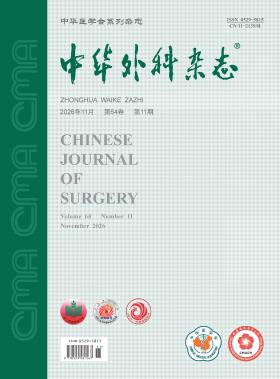
Chinese Journal of Surgery

Editorial Office of the Journal
Chinese Journal of Surgery is a comprehensive high-level academic journal of surgery sponsored and directly published by the Chinese Medical Association. The aims of the journal are to reflect major advances in surgical clinical work and related research in China and to strive to promote academic exchange at home and abroad.
The journal is intended for surgeons at all levels and related research personnel, with attention to both popularization and improvement. It mainly reports leading scientific research achievements and clinical diagnosis and treatment experience in various disciplines (specialties) in the field of surgery, as well as basic theoretical research that is closely integrated with surgical clinical practice and provides guidance for surgical clinical work.
Scope of solicited manuscripts
Practical experience and research progress in the prevention and treatment of diseases in various disciplines (specialties) in the field of surgery, new surgical theories and technologies, research on the integration of basic medicine with surgical clinical practice, academic debates, academic commentary, conference proceedings or news reflecting academic trends at home and abroad, academic lectures, academic reviews, case reports, etc.
Requirements for manuscripts
(1) Submission method and general requirements
Submitted manuscripts must be reviewed by the institution of the first author or corresponding author, and must be accompanied by the "Chinese Medical Association Series Journals Manuscript Submission Introduction Letter" (abbreviated as the "Introduction Letter") affixed with the official seal of the first author's institution. The "Introduction Letter" must be issued by the unit that enjoys the intellectual property rights of the research (that is, the unit that established the research project or the unit where the case data are located). For multicenter research, the "Introduction Letter" may be issued by the institution of the first author or corresponding author who serves as the leader of the research. The "Introduction Letter" should certify the authenticity of the manuscript content and data, and state the review comments on the manuscript as well as matters such as no duplicate submission, no involvement of confidentiality, and no dispute over authorship. If confidentiality is involved, a certificate from the relevant department approving publication must be attached. The submission must also be accompanied by the "Chinese Medical Association Series Journals Manuscript Submission Authorization Letter" (abbreviated as the "Authorization Letter"). It should be signed by all authors of the manuscript in the order of authorship, with the date of signature attached.
When submitting, authors should enter the "Chinese Medical Association Journals Academic Journal Publishing Service Platform" (https://medpress.yiigle.com), register, click "New Submission"-"Regular Submission," select Chinese Journal of Surgery, and then submit according to the page prompts. After successful submission, the system will automatically generate a manuscript number. Authors should then mail the manuscript's "Introduction Letter" and "Authorization Letter" to the editorial office of this journal (mailing address: Room 319, No. 69 Dongheyan Street, Xicheng District, Beijing, Postal code: 100052, Telephone: 010-51322407). The manuscript review fee can be paid online in the "Manuscript Fees" module of the system.
(2) Style and length
Manuscripts should be innovative, scientific, directive, and practical. The writing must be accurate, concise, smooth, and focused. Original article manuscripts generally should not exceed 6,000 characters (including abstract, figures, tables, and references). The length of lectures, reviews, conference proceedings, and clinicopathological (case) discussion manuscripts may be determined according to the situation.
1. Commentary articles (including editorials and expert forums): These are articles with strong directive value in the specialty field and are generally solicited by the editorial office from well-known experts in the field. Editorials should summarize and evaluate the current research status and future development direction of a certain field, and their views should reflect mainstream trends in the academic community. When writing an expert forum, the author may focus on a specific issue in a certain field, combine existing research results, introduce the author's experience, express the author's views, and provide corresponding supporting evidence.
2. Original articles (including research reports, clinical investigations, and brief reports): They may be written in the four-part structure of introduction, materials (subjects) and methods, results, and discussion. The introduction should briefly state the background of the study design, the research methods used, and the intended purpose, and should cite references, preferably in 200-300 characters. The research methods should clearly state the research type, and the key information of the research type should be reflected in the abstract and title. Specific content includes: (1) clinical research or experimental research; (2) prospective study or retrospective study; (3) case series study, case-control study, cohort study, non-randomized controlled study, or randomized controlled study. The results should correspond one-to-one with the methods, and commentary sentences should be avoided. Results appearing in the discussion must be presented in the results section above.
3. Reviews: A review objectively summarizes and states the current research status of a certain issue in a certain field. Topics with relatively great research progress at present should be selected, and topics with slow development should not be selected. References within 5 years should be selected as far as possible. The text should use the third person, and direct expression of one's own views should be avoided.
4. Meta-analysis: Meta-analysis requires strict selection of documents that meet the requirements (clinical randomized controlled studies) for analysis, with strict inclusion and exclusion criteria, appropriate topic selection, and scientific and rigorous methods. The selection of search databases should be comprehensive and representative, and the source journals of the literature should also be appropriately selected.
5. Case reports: Case reports should select cases whose diagnosis and treatment process has special features and can provide inspiration for the clinical diagnosis and treatment of similar cases; simple accumulation of rare cases should be avoided. Case data should be detailed and should include chief complaint, history of present illness, past history, physical examination, laboratory tests, imaging examinations, diagnosis, treatment methods, pathological examination, prognosis, etc. Examination results of important reference significance for diagnosis and treatment should be described in focus. Innovative treatment methods should also be described in detail. The discussion section should briefly comment on the diagnosis and treatment characteristics of the case, and a literature review should be avoided.
6. Clinical guidelines and consensus: There should be a scientific preliminary research foundation and evidence-based medical support, the formulating body should be the academic representative group of the discipline, and the content should have undergone sufficient expert argumentation.
(3) Title
Strive to be concise and eye-catching and to accurately reflect the theme of the article. The Chinese title should generally be within 25 Chinese characters; subtitles are best avoided, and punctuation is generally not used. Abbreviations should be avoided as much as possible. The English title should not exceed 10 content words. The meanings of the Chinese and English titles should be consistent.
(4) Authorship
Authors should simultaneously meet the following four conditions: (1) participated in the selection and design of the paper, or participated in the analysis and interpretation of data; (2) drafted or revised the key theories or other main content of the paper; (3) can revise according to the editorial office's revision opinions, answer academic questions, and finally agree to publication of the paper; (4) in addition to being responsible for their own research contributions, agree to be responsible for integrity issues in all aspects of the research work. Those who only participated in obtaining funding or collecting data cannot be listed as authors, and those who only generally managed the research group are also not suitable to be listed as authors. Author names are arranged in order below the title. The order should be discussed and determined jointly by all authors before submission and should not be changed after submission. If changes are truly necessary, a certificate from the institution and a written certification signed by all authors stating that there is no objection to the authorship must be presented. When authors come from different institutions or departments, each author's institution, department, city, and postal code must be listed; authors and institutions should be matched one-to-one with superscript 1, 2, 3, etc. Below the author's institution, the corresponding author and their Email and telephone number must be listed. The English author and institution information should correspond to the Chinese.
(5) Abstract
Original articles, commentary articles (editorials, expert forums), and review articles (reviews, expert lectures) must be accompanied by Chinese and English abstracts. Original article manuscripts should be written in the structured abstract format. The abstract should use the third person, and its content should include "目的(Objective)", "方法(Methods)", "结果(Results)", and "结论(Conclusions)". The abstract should not include figures or tables, should not cite references, and should not add comments or explanations. Commentary and review articles should be written in the indicative abstract format, summarizing and presenting the main content of the article.
Because this journal is indexed by MEDLINE and many other internationally famous retrieval systems, in order to facilitate foreign readers' understanding of the important content of the research and to enhance international exchange, the Chinese abstract may be appropriately brief and concise (generally within 400 characters), while the English abstract may be relatively specific (generally within 600 content words), so as to appropriately increase the amount of English information.
(6) Keywords
Original article manuscripts should be indexed with 3-8 Chinese and English keywords. They should be selected as far as possible from the MeSH database of the U.S. National Library of Medicine (www.ncbi.nlm.nih.gov/mesh), and their Chinese translations may refer to the Annotated Alphabetic List of Medical Subject Headings compiled by the Institute of Information of the Chinese Academy of Medical Sciences. New professional terms (free terms) not included in the thesaurus may be used directly as keywords and placed last. Traditional Chinese medicine keywords should be selected from the Traditional Chinese Medicine Subject Headings compiled by the Institute of Traditional Chinese Medicine Information of the China Academy of Chinese Medical Sciences.
(7) Statistical methods
1. Statistical symbols: According to the relevant provisions of GB/T 3358.1-2009 "Vocabulary and Symbols for Statistics," they shall all be in italics.
2. Study design: The name and main methods of the study design should be stated. For example, survey design (whether prospective, retrospective, or cross-sectional survey research), experimental design (the specific design type should be stated, such as self-paired design, grouped design, crossover design, factorial design, orthogonal design, etc.), clinical trial design (the phase of the clinical trial and what blinding measures were used, etc.); the main practices should be briefly explained around the 4 basic principles (repetition, randomization, control, balance), and in particular, how to control the interference and influence of important non-experimental factors should be stated.
3. Expression and description of data: Use x¯±s to express quantitative data approximately following a normal distribution, and use M (IQR) to express quantitative data with a skewed distribution; when using relative numbers, in principle the denominator should not be less than 20, and attention should be paid to distinguishing rates from constituent ratios.
4. Selection of statistical analysis methods: For quantitative data, appropriate statistical analysis methods should be selected according to the type of design used, the conditions of the data, and the purpose of analysis, and the t test and one-way analysis of variance should not be blindly applied; for qualitative data, appropriate statistical analysis methods should be selected according to the type of design used, the nature of the qualitative variables, the conditions of the frequencies, and the purpose of analysis, and the χ2 test should not be blindly applied. For regression analysis, an appropriate regression type should be selected in combination with professional knowledge and scatter plots, and simple linear regression analysis should not be blindly applied; repeated experimental data should not be handled in a simplified manner; for multi-factor and multi-index data, multivariate statistical analysis methods should be used as much as possible on the basis of univariate analysis, so as to provide a comprehensive and reasonable explanation and evaluation of the interaction between factors and the internal relationships among multiple indicators.
5. Interpretation and expression of statistical results: The specific name of the statistical method used should be stated (such as: t test for grouped design data, analysis of variance for two-factor factorial design data, q test for pairwise comparison among multiple means, etc.), and the specific values of the statistics (such as: t=3.455, χ2=4.687, F=6.797, etc.). The statistics and P values should be accurate to 3 decimal places; when using inequalities to express P values, generally use the three expressions P>0.05, P<0.05, and P<0.01, and there is no need to further subdivide into P<0.001 or P<0.000 1. When involving population parameters (such as population mean, population rate, etc.), while giving the significance test results, also give the 95% CI.
(8) Medical terminology
Terms published by the National Committee for Terms in Sciences and Technologies should be used. For disciplinary terms that have not yet been approved, subject terms in the latest editions of Medical Subject Headings (MeSH), the Annotated Alphabetic List of Medical Subject Headings, and the Traditional Chinese Medicine Subject Headings may be selected. For terms without a common translated name, the original term should be noted when it first appears in the text. Chinese and Western drug names shall be based on the latest editions of the Pharmacopoeia of the People's Republic of China and the General Names of Drugs in China (both compiled by the Chinese Pharmacopoeia Commission). When a trade name really needs to be used, its generic name should first be noted.
(9) Figures and tables
1. Figures: Figures should be numbered consecutively according to the order in which they appear in the main text. Each figure should have a figure title and corresponding explanation. Figures are recommended to be in TIF format. The image resolution of digital photographs should be 300 dpi or above, and the total pixels should be 1.5 million pixels or above. Histological (pathological) figures should indicate the staining method and magnification. Gross specimen photographs should have a scale mark in the figure. If a figure is a human portrait, the person's written consent should be obtained, or the part by which the person can be identified should be covered. Line drawings should have clear and continuous lines, and the height-to-width ratio should preferably be 5:7. If a figure is reproduced from other literature, the source should be indicated.
2. Tables: Three-line tables are recommended (top line, header line, bottom line). If there is a total row or statistical processing content (such as t value, P value, etc.), a dividing horizontal line should be added above this row; data in the table should have the same number of significant digits for the same indicator, generally determined by 1/3 of the standard deviation.
(10) Units of measurement
This journal implements the relevant provisions of GB 3100/3101/3102-1993 "The International System of Units and Its Application/General Principles Concerning Quantities, Units and Symbols/(All Parts) Quantities and Units." For specific implementation, refer to the 3rd edition of Applications of Legal Units of Measurement in Medicine compiled by the Chinese Medical Association Journals Publishing House (People's Military Medical Press, 2001). Note that unit names and unit symbols must not be mixed. When there is more than 1 slash indicating division in a combined unit symbol, it should be expressed in the form of negative powers, and slashes and negative powers in combined units must not be mixed. For example, ng/kg/min should be expressed as ng·kg-1·min-1, and it is not appropriate to use the form ng/kg-1·min-1. In narration, the values in legal units of measurement should be listed first, with the values in old units in parentheses; if the same unit of measurement appears repeatedly, the conversion factor between legal and old units may be noted when it first appears, and thereafter only the values in legal units of measurement should be listed. Blood pressure is still expressed in mmHg.
(11) Numbers
This journal implements GB/T 15835-2011 "General Rules for Writing Numerals in Publications." Gregorian centuries, decades, years, months, days, times, and counts and measurements should all use Arabic numerals. For ranges and deviations of percentages, the percent sign of the first number cannot be omitted, for example: 5%-95% cannot be written as 5-95%, and (50.2±0.6)% cannot be written as 50.2±0.6%. When numerical values with dimension units are multiplied, write as follows: 4 cm×3 cm×5 cm, and cannot be written as 4×3×5 cm3.
(12) References
Refer to GB/T 7714-2015 "Information and Documentation-Rules for Bibliographic References and Citations." Use the sequential coding system, numbering according to the order in which they appear in the text with Arabic numerals, placing the numbers in square brackets, and arranging them after the text. Internal publications, unpublished materials (excluding accepted materials awaiting publication), personal communications, etc. are generally not cited as references. If there are special circumstances where citation is truly necessary, they may be noted in the corresponding place in the main text. Japanese kanji should be written according to Japanese regulations and should not be confused with Chinese characters and simplified characters. For the same reference, if there are no more than 3 authors, all should be cited; if there are more than 3, only the first 3 should be cited, followed by the corresponding expression for ", et al." according to the language. Author names should always have the surname first and the given name last. Foreign names should use initials, and no abbreviation period should be added after the abbreviated given name; different author names should be separated by ",". Please indicate the document type mark after the title. For document type and electronic document carrier mark codes, refer to the "Codes for Document Types and Document Carriers" in GB/T 7714-2015 "Information and Documentation-Rules for Bibliographic References and Citations." Foreign journal names should use abbreviations, and the format recommended by the International Committee of Medical Journal Editors, NLM's Citing Medicine (www.ncbi.nlm.nih.gov/books/NBK7256), may be used. Chinese journal names should use the full name. Journals should be marked with the issue number. Each reference must include the start and end pages and DOI. Examples are as follows:
[1] Peng Ying, Xiu Dianrong, Jiang Bin, et al. Clinical study on the use of two definition standards to judge the R1 margin of resection specimens of pancreatic head ductal adenocarcinoma [J]. Chinese Journal of Surgery, 2014, 52(11):834-838. DOI:10.3760/cma.j.issn.0529-5815.2014.11.012.
[2] Kingsnorth AN, LeBlanc KA. Surgical treatment of abdominal wall hernia [M]. Tang Jianxiong, Huang Lei, trans. 4th ed. Shanghai: Shanghai Scientific and Technical Publishers, 2014:225-227.
(13) Funding and clinical trial registration information
If the project involved in the paper is a national, ministerial, provincial or higher-level fund or key project, it should be identified below the Chinese (English) keywords in the article with "基金项目(Fund program):" as the label, noting the name of the fund program and, in parentheses, its project number. The name of the fund program should be filled in according to the official name prescribed by the relevant state departments. Multiple funds should be listed in sequence, separated by a semicolon ";". For example, "基金项目:国家自然科学基金(30271269);‘十五’国家高技术研究发展计划(2003AA205005)", and a copy of the relevant fund project certificate should be attached. If the project involved in the paper has been registered for clinical trials, the registration number should be listed after the fund program.
(14) Medical ethics and informed consent
Basic principles of medical ethics must be followed. When the research in the paper uses human subjects, the authors should explain whether the procedures followed conform to the ethical standards formulated by the committee responsible for human experimentation (institutional, regional, or national). The approval document of that committee (with the approval number cited in the paper) and the informed consent form of the subjects or their relatives should be provided.
(15) Conflicts of interest and author contribution statements
These should be noted after the text and before the references. If there is no conflict of interest, it may be noted that "所有作者声明不存在利益冲突" (All authors declare no conflicts of interest); if there is a conflict of interest, it should be noted according to the actual situation. Original research articles must all include an author contribution statement, specifying what specific work each author did in the planning, implementation, and reporting of the study.
Manuscript processing
(1) Review
This journal implements a three-review system based on peer review (initial review by editors, external review by experts, and final review by the editorial board). At the time of submission, authors must inform the journal of any potential conflicts of interest related to the study (that is, whether there are conflicts of interest caused by economic interests or other factors). During the review process, the confidentiality of authors' manuscripts is protected. For manuscripts not intended for publication, rejection comments will be communicated. If authors do not agree with the review or editorial revision opinions, they may apply to the editorial office or the General Editorial Office of the Chinese Medical Association Journals Publishing House for reconsideration, and submit a written explanation of their appeal (editorial office Email: cmacjs@cmaph.org). During the manuscript review process, if authors wish to withdraw the manuscript or submit it to another journal, please first contact this journal and provide an explanation.
(2) Time limit for manuscript processing
According to the Copyright Law of the People's Republic of China and in light of the actual situation of this journal, if no notice of manuscript processing status is received within 3 months after receiving the receipt acknowledgment from this journal, the manuscript is still under review. If authors wish to submit it to another journal, they must contact the editorial office in advance; otherwise, it will be regarded as duplicate submission and the manuscript will be rejected.
(3) Manuscript revision
For manuscripts that have been initially decided for publication after review, the editorial office of this journal will send revision opinions to the authors. After organizing according to the revision opinions proposed by the editorial office, authors should send the revised manuscript to the editorial office of this journal through the manuscript management system as soon as possible. If, from the date the editorial office sends the revision opinions, the revised manuscript or the authors' explanation is still not received after 1 month, it will be regarded as the authors' automatic withdrawal.
(4) Matters concerning copyright
1. Authors are responsible for the authenticity and scientific nature of their manuscripts. In accordance with the relevant provisions of the Copyright Law of the People's Republic of China, this journal may make textual modifications and deletions to submitted manuscripts.
2. After all authors personally sign the "Authorization Letter," the exclusive right to use the paper shall belong to the Chinese Medical Association; the Chinese Medical Association has the right to publish the published paper in electronic journals, CD-ROM editions, APP terminals, WeChat, and other ways. Without the consent of the Chinese Medical Association, no part of the paper may be reproduced elsewhere.
3. After a manuscript is confirmed for publication, the relevant publication fee must be paid according to the amount in the notice. Those requesting color figure printing must pay an additional cost for color figure printing. After publication, an appropriate remuneration will be given (including remuneration for publication in other forms), and 2 copies of the current issue will be presented.
(5) Handling of duplicate submission
This journal condemns and resists duplicate submission or even multiple submission. Once duplicate submission is discovered, the manuscript will be rejected immediately; once duplicate publication is discovered, the following handling will be applied: (1) publish a statement retracting the paper and stating that the article is a duplicate publication, and circulate a notice in the Chinese Medical Association series journals; (2) notify the authors' institutions and other academic journals in the field; (3) this journal will refuse to publish any submission with the first author of that article as an author within 2 years.
CURRENT ISSUE