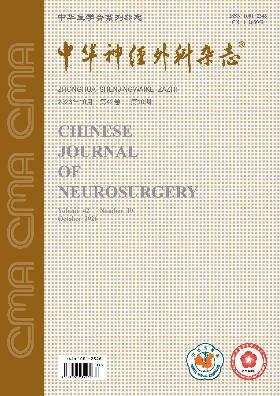
Chinese Journal of Neurosurgery

Chinese Journal of Neurosurgery is a core academic journal specializing in neurosurgery, sponsored by the Chinese Medical Association. Targeting neurosurgeons and researchers in related disciplines, it reports leading research achievements, clinical diagnosis and treatment experience in neurosurgery, as well as basic theoretical studies closely related to neurosurgical practice.
The journal features sections including Guidelines, Expert Consensus, Editorial, Original Clinical Articles, Basic Research Articles, Surgical Techniques, Technical Improvements, Case Reports, Expert Lectures, Academic Debates, Case (Pathology) Discussions, Reviews, Meeting Minutes, Knowledge Links, Continuing Education, Letters to the Editor, Domestic and International Academic Updates, and Announcements of Academic Events. Editorials are mostly commissioned papers. The journal prioritizes publishing clinical research articles.
I. Instructions for Submission
1. Manuscript requirements: Submitted manuscripts shall demonstrate innovation, scientific rigor, guidance value and practicality. The content must feature authentic data, accurate statistics, clear arguments, sound study design and concise wording. Original articles and reviews shall generally not exceed 6,000 words (including abstracts, figures, tables and references); case reports and technical improvements shall generally not exceed 2,000 words. Original research papers shall cite no fewer than 15 references.
2. Submission method: Manuscripts shall be submitted via the website https://medpress.yiigle.com. After registration, please read the author guidelines, download and complete the Paper Authorization Form for Chinese Medical Association Series Journals and Paper Submission Introduction Letter for Chinese Medical Association Series Journals. Sign and affix official seals to the documents before mailing them to the editorial office. If confidentiality issues are involved, an approval statement for publication issued by the competent authority shall be attached. Do not submit the same manuscript to more than one journal simultaneously. Upon submission, authors must state whether the manuscript has been published in non-public journals or presented at academic conferences. Neither circumstance constitutes duplicate submission.
3. Submission requirements: The first page of the manuscript shall contain the title, full names of all authors, affiliations of the first author and corresponding author, postal codes, telephone numbers and email addresses. A manuscript processing fee of 100 RMB per article is required at submission.
4. Contact information: (1) Mailing address: Room 1001, 10th Floor, Beijing Neurosurgical Institute, Building 1, Zone 2, No.119 South Fourth Ring West Road, Fengtai District, Beijing 100070, Editorial Office of Chinese Journal of Neurosurgery. Do not send documents to individual staff members. (2) Telephone: 010-59975481. (3) Email: cjns65113169@vip.sina.com.
5. Medical ethics and informed consent: Manuscripts must comply with basic medical ethical principles. For human-subject studies, authors shall provide the approval document from the human research ethics committee (the approval number shall be stated in the manuscript) and informed consent forms signed by study participants or their relatives. For animal studies, authors shall specify compliance with institutional and national regulations governing laboratory animal care and use. If ethical approval is obtained, the approval document and approval number from the laboratory animal ethics review committee shall be provided.
6. Conflicts of interest: At submission, authors shall submit a conflict-of-interest disclosure statement (template available for download on the homepage of the submission website), detailing all financial and non-financial relationships. Authors are responsible for the authenticity of the statement, and the corresponding author shall sign the form. If all authors confirm no actual or potential conflicts of interest, the following statement shall be added at the end of the article: “All authors declare no conflicts of interest.”
7. Author contribution statement: An author contribution statement (template available for download on the homepage of the submission website) shall be submitted together with the manuscript, specifying the concrete contributions of each author to study design, implementation and manuscript reporting.
8. Fund projects: If the research is supported by national, ministerial, provincial or higher-level funds or key research programs, the funding information shall be indicated. Fund items shall be marked in both Chinese and English below the Chinese and English keywords. Basic research articles must be supported by provincial or higher-level research grants.
9. Fast-track review: Major research achievements may be published through the fast-track channel to shorten publication time. Authors shall provide a written statement describing the innovation of the work, a novelty search report and recommendation letters from 2 experts to verify the academic value of the research. Upon approval, the article will generally be published within 4 months after receipt. A peer review fee of 200–400 RMB shall be paid.
10. Copyright provisions: (1) Authors are responsible for the authenticity and scientific validity of their manuscripts. In accordance with the Copyright Law of the People’s Republic of China, the journal reserves the right to edit and abridge manuscripts. Revisions altering the original meaning will be referred back to the authors for consideration. Failure to return revised manuscripts within one month will be regarded as automatic withdrawal. (2) Once a manuscript is accepted for publication and the Paper Authorization Form for Chinese Medical Association Series Journals is signed by all authors, the exclusive right to use the article shall belong to the Chinese Medical Association. The Chinese Medical Association may publish the article in electronic journals, CD-ROM editions and other formats. No part of the article may be reproduced elsewhere without permission from the Chinese Medical Association. (3) After acceptance, page charges shall be paid as notified. Extra fees apply for color figure printing if color illustrations are requested.
11. Review policy and manuscript handling: The journal adopts a three-tier peer review system consisting of preliminary editorial review, external expert review and final editorial board review. In accordance with the Copyright Law of the People’s Republic of China and the journal’s practice, if authors receive no manuscript decision notification within 3 months after the receipt confirmation, the manuscript remains under evaluation. If authors intend to submit the manuscript to another journal, they must contact the editorial office in advance; otherwise, the case will be treated as duplicate submission and the manuscript will be rejected. Once duplicate publication is confirmed, the journal will publish a retraction notice for the article and reject all future submissions by the first author for 2 years.
II. Manuscript Preparation Requirements
1. Title: Titles shall be concise and informative, reflecting the core theme of the article. Except for widely accepted terms, foreign abbreviations shall not be used. Chinese titles shall generally contain no more than 25 Chinese characters. Subtitles are discouraged; punctuation marks and abbreviations should be avoided whenever possible. Chinese and English titles shall be consistent in meaning.
2. Author attribution: The author list and order shall be finalized at submission and shall not be modified during production. Superscript numbers shall be marked after author names, and corresponding numbers shall precede institutional affiliations to match authors with their institutions. For collectively authored papers, a corresponding author must be identified with full name and email address. If foreign authors are included, written proof confirming their consent for authorship shall be attached.
3. Institutional affiliation: Chinese institutional affiliations shall include the full official name and postal code. In principle, one author shall be affiliated with only one institution (the administrative unit the author belongs to. If the author’s administrative affiliation differs from the institution where the research was designed, performed and supported, or if authors come from multiple organizations, the affiliation shall be the institution that provided research resources and hosted the study). If multiple affiliations are necessary, the submission introduction letter must bear official seals from all listed institutions on a single document, and the first author’s primary affiliation must be the source institution of the research data.
4. Abstract: Original articles require both Chinese and English structured abstracts covering four sections: Objective, Methods, Results (present key quantitative data) and Conclusion. Abstracts shall be written in the third person without pronouns such as “this paper”. The English abstract shall be preceded by the English title, all author names (Pinyin: capitalize only the first letter of the surname, no hyphen between given names, e.g. Wang Minde), full institutional names, city names, postal codes and country names. If authors belong to different institutions, marking rules follow the Chinese version. When a corresponding author exists, start a new line after affiliations with “Corresponding author” followed by the corresponding author’s name and email. All other paper types (editorials, special articles, short original articles, reviews, continuing education articles, etc.) shall include a descriptive Chinese abstract of 100–200 words unless otherwise specified.
5. Keywords: Original articles shall list 3–8 keywords. The first keyword shall be selected from the MeSH database of the United States National Library of Medicine. Chinese translations may refer to the newly compiled Chinese Medical Subject Headings Annotated Alphabetic List by the Institute of Medical Information, Chinese Academy of Medical Sciences. Recognized standard domain terms may be added as free words and placed at the end when necessary.
6. Clinical trial registration number: The clinical trial registration number shall be the globally unique identifier obtained from a WHO-recognized primary clinical trial registry. It shall be placed at the end of the abstract under the heading “Trial registration”, stating the registry name and registration number. Abstracts of prospective clinical trial original articles shall contain essential elements specified by the CONSORT statement (http://www.consort-statement.org/home).
7. Medical terms: Medical terms shall adopt the standardized terms published by the China National Committee for Terms in Sciences and Technologies. Terms not yet standardized may be selected from the latest Medical Subject Headings (MeSH), Chinese Medical Subject Headings Annotated Alphabetic List and Traditional Chinese Medicine Subject Headings. Terms without accepted Chinese translations shall include the original term at their first occurrence in the text. Pharmaceutical names shall follow the latest edition of Pharmacopoeia of the People’s Republic of China and Chinese Generic Drug Names compiled by the Chinese Pharmacopoeia Commission. If trade names must be used, the generic name shall be stated first. Traditional Chinese medicinal materials shall use official names; materials not recorded in the pharmacopoeia shall be annotated with Latin names.
8. Statistics: (1) Specify the statistical software and exact statistical methods applied (e.g., independent-samples t test, two-factor factorial analysis of variance). (2) Describe the study design and key approaches: prospective, retrospective or cross-sectional study; specify sampling methods for research subjects. (3) Data presentation. Use $\bar{x}\pm s$ for quantitative data approximately following normal distribution; use $M(Q_1,Q_3)$ or $M(IQR)$ for skewed quantitative data. For relative numbers, the denominator should preferably not be less than 20. Distinguish between percentage and constituent ratio. (4) Selection of statistical methods. Choose appropriate statistical approaches for quantitative and qualitative data; avoid indiscriminate use of t test, one-way ANOVA or $\chi^2$ test. For multivariate and multi-indicator datasets, multivariate statistical methods are recommended in addition to univariate analysis. (5) Interpretation and reporting of statistical results. When $P<0.05$, state that the between-group difference is statistically significant, not “significantly different”. Report exact test statistics and P values (e.g., $t=2.35$, $\chi^2=5.65$; $P=0.601$).
9. Figures and tables: Figures and tables shall be placed after the main text and numbered sequentially according to their first citation in the manuscript. Each figure or table must have a concise title. Explanatory notes and definitions of nonstandard abbreviations shall be placed in captions below the figure or table. Three-line tables are recommended; row and column headings should be clearly defined and data meaning expressed unambiguously. Within each table, the same indicator shall have consistent significant digits. Line graphs must have clear Chinese labels on horizontal and vertical axes; symbols and arrows in figures shall be explained in captions. For pathological images, state the staining method in the figure legend; images shall include scale bars. If no scale bar is present, state the magnification factor in the caption.
10. Units of measurement: Follow GB3100~3102-1993 International System of Units and Its Application / General Principles for Quantities, Units and Symbols / Quantities and Units (all parts). For practical usage, refer to Application of Legal Measurement Units in Medicine (3rd Edition) compiled by Chinese Medical Journal Press (People’s Military Medical Press, 2001).
11. Numerals: Follow GB/T 15835-2011 General Rules for Writing Numerals in Publications. Arabic numerals are used for Gregorian centuries, decades, years, months, days, time points, counting and measurements. For numbers with four or more digits before or after the decimal point, insert a quarter-space every three digits. Ordinal numbers, page numbers, years, military unit designations, instrument model numbers and standard numbers shall not be spaced. For percentage ranges and deviations, the percent symbol must be retained for the first value: e.g., 5%–75% not 5–75%, (25.3±6.5)% not 25.3±6.5%. For multiplied values with dimensional units, repeat the unit after each number: e.g., 4 cm×4 cm×4 cm.
12. Abbreviations: Avoid abbreviations in titles. Minimize abbreviations to preserve readability. When necessary, provide the full Chinese name on first use, followed by the Chinese abbreviation or full English term and English abbreviation in parentheses. Directly usable abbreviations approved by the journal do not require full English expansion.
13. References: References shall comply with GB/T 7714-2015 Information and Documentation — Rules for Bibliographic References. References are arranged sequentially in citation order at the end of the manuscript. Internal publications, unpublished materials (excluding manuscripts accepted for publication) and personal communications shall not be cited. List all authors for references with up to 3 authors; for more than 3 authors, list the first 3 followed by “et al”. Separate author names with commas. Add document type identifiers after article titles. Document type and electronic carrier codes follow GB/T 7714-2015 Information and Documentation — Bibliographic Reference Type and Carrier Code. Foreign journal titles are abbreviated following Index Medicus conventions; Chinese journal titles are written in full. Journal references must include volume, issue and page range. DOIs must be included for articles with DOIs at the end of each reference entry. Example:
[1] He WL, Yuan F, Zhang YZ, et al. Meta-analysis of bromocriptine for prolactinomas in China[J]. Chinese Journal of Neurosurgery, 2012, 28(9): 873-918. DOI: 10.3760/cma.j.issn.1001-2346.2012.09.018.
Reference format for articles published online first: Primary author. Title: other title information[Document type/Carrier type]. Journal name, year, volume (update date)[citation date]. Access URL. DOI. [published online ahead of print]. Example:
[2] Das RC. Forecasting incidences of COVID-19 using Box-Jenkins method for the period July 12-September 11, 2020: a study on highly affected countries[J/OL]. Chaos Solitons Fractals, 2020, 140 (2020-08-24)[2021-10-28]. https://www.ncbi.nlm.nih.gov/pmc/articles/PMC7444906/. DOI: 10.1016/j.chaos.2020.110248. [published online ahead of print].
III. Retraction and Retraction Notice
Papers previously published in this journal will be retracted with a formal retraction notice published in the journal if the article involves serious academic misconduct, violation of medical ethical standards, duplicate publication, or severe flaws occurring during the publication process.
CURRENT ISSUE