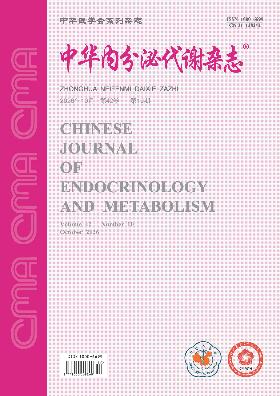
Chinese Journal of Endocrinology and Metabolism

Chinese Journal of Endocrinology and Metabolism was founded in July 1985. It is a high-level academic journal specialized in endocrinology and metabolism, sponsored by the Chinese Medical Association. Adhering to the mission of being “a Chinese disseminator of global new knowledge in endocrinology and metabolism”, the journal reports cutting-edge research achievements and clinical diagnosis and treatment experience in endocrinology, metabolism and related fields, as well as basic theoretical research closely integrated with and guiding clinical practice in endocrinology and metabolism. The journal is indexed in domestic and international databases including Chinese Core Journals for Science and Technology, Chinese Scientific and Technical Papers and Citations Database, Chemical Abstracts and Scopus.
I. Columns of the journal include Original Articles, Short Original Articles, Editorials, Case Reports, Clinical Case Management, Debates, Reviews, Meeting Minutes, Continuing Education on Endocrine Disease Management, and Selected Translations of Foreign Journals. Feature Articles, Editorials, Reviews and manuscripts interpreting guidelines/consensus are mostly commissioned by the Editor-in-Chief and Associate Editors. Reviews shall contain the authors’ own research work and relevant research foundations in the field.
II. Requirements for Manuscripts
1. Manuscripts shall be innovative, scientific, instructive and practical.
2. Manuscripts shall be accurate, concise, fluent and focused. Original articles shall not exceed 5,000 words (including abstracts, figures, tables and references). The word count for discussion-type manuscripts such as lectures, reviews, meeting minutes and case reports may be adjusted as appropriate.
3. Manuscripts shall comply with national standards or industrial specifications, and refer to the Formatting Specifications for Journals of the Chinese Medical Association for detailed requirements.
(1) Medical terms: Terms issued by the China National Committee for Terms in Sciences and Technologies shall be adopted. Chinese and western drug names shall follow the latest edition of Pharmacopoeia of the People's Republic of China and Chinese Generic Drug Names (both compiled by the Chinese Pharmacopoeia Commission). If trade names must be used, the generic name shall be stated first. Official names shall be adopted for Chinese medicinal materials; Latin names shall be attached for those not included in the pharmacopoeia.
(2) Language: Comply strictly with the Law of the People's Republic of China on the Standard Spoken and Written Chinese Language (2000-10-31), the Notice on Further Standardizing the Use of Characters in Publications issued by the General Administration of Press and Publication on December 24, 2010, and the Provisions on the Administration of Chinese Characters in Publications issued by the General Administration of Press and Publication and State Language Work Committee in 1992. The List of Simplified Chinese Characters reissued by the State Language Work Committee in October 1986 and the General Modern Chinese Character Table issued by the State Language Work Committee and General Administration of Press and Publication in March 1988 shall prevail.
(3) Reference formatting: The sequential coding system is adopted. Arabic numerals enclosed in square brackets are used to mark references in the order of citation in the text and listed at the end of the paper. If multiple consecutively numbered references are cited at one place in the main text, an en dash is used, e.g. [1-2]; for non-consecutive references, commas are used, e.g. [1,4], [1-2,4].
When listing references, all authors shall be recorded if there are no more than 3; if more than 3 authors, only the first 3 are listed, followed by the expression ", et al." in the corresponding language. Author names are written with surname first, followed by given name. For foreign authors, given names are abbreviated without periods after abbreviations; different authors are separated by commas.
A document type identifier shall be marked after the article title. Foreign journal titles are abbreviated following the format in NLM’s Citing Medicine (http://www.ncbi.nlm.nih.gov/books/NBK7256) recommended by the International Committee of Medical Journal Editors. Chinese journal titles are written in full. The DOI shall be recorded at the end of each reference entry if available.
Example: [1] Liu Xin, Shen Yang, Hong Kui. Genetic testing and management for risk of sudden cardiac death[J]. Chinese Journal of Cardiology, 2015, 43(9): 760-764. DOI: 10.3760/cma.j.issn.0253-3758.2015.09.003.
4. Clinical trial registration number: The clinical trial registration number shall be a globally unique registration number obtained from a WHO-recognized primary clinical trial registry. It shall be placed after the Chinese and English abstracts under the heading “Trial registration” (same font and size as other subheadings in the abstract), with the name of registration body and registration number.
5. Statistical methods and presentation of results: A detailed description shall be provided, including study design, data description, selection of statistical analysis methods, interpretation and presentation of statistical results. Statistical symbols shall be italicized. Numerical values of statistics shall be presented. Skewed quantitative data are expressed as M(Q1,Q3) or M(IQR), where M and Q are italicized and subscript numbers are in roman type. Mean ± standard deviation is expressed as $\bar{x}\pm s$; Mean±SD is used in English abstracts. P values are accurate to three decimal places and statistics to two decimal places. P=0.000 shall be written as P<0.001. Superscript symbols shall be selected in the order of a, b, c…
6. Medical ethics and informed consent: The basic principles of medical ethics must be followed. If human subjects are involved in the study, authors shall state whether the implemented procedures comply with ethical standards formulated by the ethics review committee (institutional, regional or national), provide the approval document issued by the committee (the approval number shall be recorded in the paper), and attach informed consent forms signed by research subjects or their relatives.
7. Submission: Authors shall register in the Remote Manuscript Processing System of the Chinese Medical Association (www.cma.org.cn) and select the target journal, or submit manuscripts via the journal’s official website (zhnfmdxzz.yiigle.com or www.endocrmetab.com). Authors shall download and complete the Submission Introduction Letter and Authorization Form for Manuscripts of Chinese Medical Association Journals and mail it to the editorial office.
Manuscripts shall be reviewed by the academic authority of the author’s institution with an institutional recommendation letter. The letter shall state approval for submission, no duplicate submission, no confidentiality issues and no authorship disputes. At submission, authors must indicate whether the manuscript has been published in non-public publications, presented at academic conferences, or published in another language (with consent obtained from the original journal). These three scenarios are not regarded as duplicate submission. The journal charges no manuscript processing fees for all submissions.
8. Authors: All listed authors shall meet the following four criteria: (1) Made substantial contributions to the conception or design of the work, or the acquisition, analysis or interpretation of data for the work; (2) Drafted the work or revised it critically for important intellectual content; (3) Approved the final version to be published; (4) Agreed to be accountable for all aspects of the work in ensuring that questions related to the accuracy or integrity of any part of the work are appropriately investigated and resolved.
The corresponding author is the primary contact for the journal during submission, peer review and publication. (1) Ensure full compliance with journal requirements for the submitted manuscript, including complete authorship information, ethics approval and clinical trial registration documents, conflict-of-interest forms and author contribution statements; (2) Respond promptly to queries during submission and peer review and comments on the work after publication; (3) Provide raw data or other information if questions arise after publication; (4) Maintain correspondence with the journal. One corresponding author shall be designated for each paper. For multi-center or multidisciplinary randomized controlled clinical trials, up to 3 corresponding authors may be appointed as appropriate.
Joint first authorship is not recommended. It shall not be marked for authors from the same department of the same institution. If joint contribution must be indicated, a contribution statement signed by all authors shall be provided. All author information (authors, affiliations with postal codes, corresponding author with email and telephone, affiliation changes, joint contribution notes, etc.) must be entered in the submission system and main text. In the main text, superscript numbers are marked after author names and matched with corresponding numbers before affiliations. In principle, one author may be affiliated with only one institution. If multiple affiliations are necessary, official seals of all listed institutions shall be affixed on the submission introduction letter, and the first author’s primary affiliation shall be the institution where the research data was generated. Full institutional names shall be used; full names shall be retained for different departments within the same institution without abbreviation. For guidelines and consensus documents, the expert panel list, writers and academic secretaries form part of the main text and shall be placed after the main text and before references.
Author order shall be determined at submission and shall not be modified during production. If foreign authors are included, a signed letter of consent for publication in this journal shall be attached. If the research was completed in a foreign laboratory, a publication approval certificate issued by that laboratory shall be provided. For collectively authored papers, affiliated institutions are listed under the title, and the compilers are noted in footnotes. The email and other contact information (postal code, full address, department and telephone) of the first author and/or corresponding author must be provided. If the first author or compiler is not the corresponding author, the name, affiliation and postal code of the corresponding author shall be indicated on the first page.
9. Abstract and Summary: Original articles shall include Chinese and English abstracts. Abstracts must consist of four sections: Objective, Methods, Results (with key data) and Conclusions, each with corresponding headings, written in third person. The Chinese abstract shall be within 500 words and the English abstract within 300 content words. The English abstract shall also include the title, author names, department and affiliation, city and postal code. Other manuscripts including short original articles, commentaries, reviews, lectures, case reports, clinical case management and continuing education papers shall include Chinese and English titles, author names and affiliations, as well as Chinese and English summaries. The Chinese summary shall be within 150 words and the English summary around 100 content words.
10. Keywords: Original articles shall generally be tagged with 3–8 keywords. Abbreviations in keywords shall be restored to their full forms. The first letter of each English keyword shall be capitalized, with two spaces between keywords.
11. Figures and tables: Each figure or table occupies a separate page and is attached after the text, numbered sequentially in the order they appear in the main text. Each figure (table) shall have a title. Descriptive notes shall be placed below figures/tables, and all non-public abbreviations used in figures/tables shall be annotated in the notes. Short original articles shall contain no more than one figure and one table. Authors preparing computer-generated figures shall provide laser-printed copies and independent electronic files (photos in JPG or TIF format with resolution ≥300 dpi; statistical charts in Excel files containing raw data), marked with figure numbers and captions. Each photograph shall be marked with manuscript ID, figure number, author name and orientation. Pathological photographs shall indicate staining methods and magnification. Photocopies of photographs are not accepted. Symbols (including arrows) to be marked on figures shall be attached on separate sheets rather than written directly on photographs. Written consent shall be obtained from individuals if portraits are published.
12. Abbreviations: When first used, the full name shall be stated followed by the Chinese abbreviation or the full English name and its abbreviation in parentheses, separated by a comma (well-known abbreviations or those listed in the journal’s abbreviation table may be used without full name). Abbreviations shall not be split across lines.
13. Funding: Funding information shall be presented bilingually, placed below the keywords of Chinese and English abstracts respectively. Funding items shall be indented two characters, set in small five-point boldface, and the content in small five-point Song typeface. A copy or electronic version of the funding certificate shall be attached at submission.
Examples:
(1) Fund program: National Key Basic Research Program of China (973 Program) (2013CB532002)
Fund program: National Key Basic Research Program of China (973 Program) (2013CB532002)
(2) Fund program: National Natural Science Foundation of China (30271269)
Fund program: National Natural Science Foundation of China (30271269)
14. Conflict of interest and author contribution statement: Conflict-of-interest disclosure forms part of the manuscript, and shall be included whether conflicts exist or not. The conflict-of-interest statement shall be placed after the main text and before references. Acknowledgements and author contribution statements shall follow the conflict-of-interest statement. Both statements shall be left-aligned at the bottom of the manuscript, set in six-point boldface for headings and six-point Song typeface for content.
15. Revised manuscripts requested by the responsible editor for accepted papers may be sent directly to the journal email via Email.
III. Peer Review
Journals of the Chinese Medical Association adopt a three-tier review system based on peer review (initial editorial review, external expert review and final editorial board review). At submission, authors must disclose potential conflicts of interest related to the study. Authors who disagree with manuscript decisions have the right to apply for reconsideration and provide written appeal statements.
IV. Manuscript Processing Time Limit
In accordance with the Copyright Law of the People's Republic of China and the journal’s actual situation, if authors do not receive manuscript processing notification within 3 months after receiving the manuscript receipt, the manuscript is still under review. If authors intend to submit the manuscript to another journal, they must contact the editorial office in advance; otherwise, it will be treated as duplicate submission and rejected.
V. Copyright Matters
1. Authors shall be responsible for the authenticity and scientific validity of the submitted manuscripts. In accordance with the Copyright Law of the People's Republic of China, the editorial office may revise and abridge the manuscripts. Any revision changing the original meaning will be referred back to the authors. If the revised manuscript is not returned within 2 months, it will be regarded as automatic withdrawal.
2. Once the manuscript is accepted for publication, after the authors sign the Submission Introduction Letter and Authorization Form for Manuscripts of Chinese Medical Association Journals, the exclusive right to use the paper belongs to the Chinese Medical Association. The Chinese Medical Association has the right to publish the paper via electronic journals, CD-ROMs and other formats. No part of the paper may be reprinted elsewhere without permission from the Chinese Medical Association.
3. After acceptance, page charges shall be paid according to the notice. Additional fees for color figure printing shall be charged if color plates are required. Two copies of the current issue will be provided to the authors after publication.
VI. Retraction
Retraction aims to correct errors in published papers. Please contact the editorial office for specific retraction procedures.
VII. Manuscript Submission Address
Editorial Office of Chinese Journal of Endocrinology and Metabolism, Room 1A03, Building 1, No.573 Xuhui Road, Huangpu District, Shanghai; Postal Code: 200023; Tel: 0086-21-64315587; Email: cjem@cmaph.org. Please provide the detailed mailing address, telephone number and Email of the author or contact person.
CURRENT ISSUE