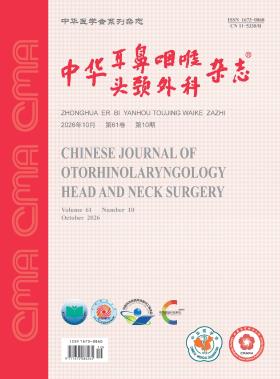
Chinese Journal of Otorhinolaryngology Head and Neck Surgery

Chinese Journal of Otorhinolaryngology Head and Neck Surgery is a professional academic journal sponsored by the Chinese Medical Association and distributed domestically and internationally. It targets otorhinolaryngologists and head and neck surgeons as primary readers. The journal reports leading research achievements, novel clinical diagnosis and treatment experience in this field, as well as basic theoretical research that guides clinical practice and is closely related to otorhinolaryngology head and neck surgery. The journal’s editorial policy is to implement national health policies, integrate theory with practice and popularization with advancement, reflect the progress of clinical practice and scientific research in otorhinolaryngology head and neck surgery in China, facilitate academic exchanges at home and abroad, and promote disciplinary development. This journal is indexed in multiple major domestic and international databases, including: Chinese Core Journals for Science and Technology (Chinese Science and Technology Paper Statistical Source Journals), Peking University Chinese Core Journal Directory, Medline, PubMed, Scopus, etc.
I. Manuscript Types Accepted
1. Editorials, expert forums, continuing education lectures with practical clinical guidance significance, literature reviews reflecting hot topics or important advances in this discipline worldwide, and academic discussions exploring controversial academic issues.
2. Clinical studies, basic theoretical research, pioneering experimental research in otorhinolaryngology head and neck surgery, experience and lessons from clinical practice, and case reports of rare cases.
3. Epidemiological survey results, and development of new technologies, new therapies and new devices.
II. Online Submission Requirements
1. Hard-copy submissions are not accepted. Please submit manuscripts via the Chinese Medical Association Journal Online Manuscript Management System (https://www.medpress.yiigle.com) or the Chinese Medical Association Journals website (http://www.cmaph.org). Upon successful submission, authors will receive an automated email with the manuscript ID (no reply to this automated message. For inquiries, contact the editorial office, Email: cjorl@cmaph.org, Tel: 010-51322448). After online submission, please pay the manuscript processing fee as prompted and mail the following hard-copy documents: (1) Submission Letter and Authorization Form: download and complete the Submission Letter for Manuscripts of Chinese Medical Association Series Journals and Paper Authorization Form for Chinese Medical Association Series Journals from the homepage of the online manuscript management system, which must be reviewed and stamped by the academic authority of the author’s institution. (2) If the study is funded by a research grant, attach a copy of the grant approval document. If confidentiality issues are involved, attach approval documents for public release issued by competent authorities.
2. Manuscripts shall be innovative, scientific, instructive and practical. Submitted manuscripts must have authentic materials, accurate data, clear arguments, rigorous structure, concise text and standardized writing. Statistical analysis shall be performed when necessary. Original articles shall generally not exceed 6,000 words (including abstract, figures, tables and references); case reports shall generally not exceed 2,500 words (2–4 images); the word count of reviews and meeting minutes may be adjusted as appropriate.
3. Medical Ethics and Informed Consent: Basic principles of medical ethics must be followed. If human subjects are enrolled in the study, authors shall state whether the adopted procedures comply with ethical standards established by institutional, regional or national ethics review committees, provide the committee’s approval document (approval number to be indicated in the manuscript) and informed consent forms from subjects or their relatives. If animal subjects are used, authors shall state compliance with national and institutional regulations on laboratory animal care and use. If ethical approval was obtained, documents and approval numbers from the laboratory animal ethics review committee shall be provided.
4. Conflict of Interest: Authors must submit a conflict-of-interest disclosure statement at submission, specifying all financial and non-financial competing interests. Authors are responsible for the authenticity of the submitted statement, and the corresponding author shall sign the conflict-of-interest disclosure form. If all authors declare no actual or potential conflicts of interest, the statement “All authors declare no conflicts of interest” shall be placed at the end of the manuscript.
5. Author Contribution Statement: Original research articles must include an author contribution statement detailing the specific work of each author in study planning, implementation and reporting. Examples: direct participation (conception and design of experiments, study implementation, data collection, data analysis/interpretation), manuscript writing (drafting the manuscript, critical revision of the intellectual content of the article), work support (statistical analysis, acquisition of research funding, administrative, technical or material support, supervision, supportive contributions), and others.
6. Funding: Studies supported by national, ministerial, provincial or higher-level grants or key research projects shall be indicated. Funding information shall be presented in both Chinese and English below the Chinese and English keywords, respectively. Format examples:
基金项目: National Natural Science Foundation of China (81701125); Shandong Key R&D Program (2017GSF18129)
Fund program: National Natural Science Foundation of China (81701125); Shandong Key R&D Program (2017GSF18129)
7. Manuscripts containing maps shall comply with China’s Regulations on Map Administration. China implements a map review system. Maps released to the public shall be reviewed by competent administrative departments of surveying, mapping and geographic information, except for simple maps such as scenic area maps, block maps and subway route maps.
8. Priority Publication for Outstanding Research Achievements: Authors of innovative, important and scientifically sound manuscripts who wish to publish via the “Priority Publication Platform for Outstanding Research Achievements” shall select the priority publication workflow during submission. In addition to regular documents, authors must provide: (1) a written application for priority publication; (2) a novelty search report issued by a municipal/provincial or higher-level library or medical information institute; (3) written recommendation letters from two peer experts with senior professional titles (at least one from outside the author’s institution); (4) a manuscript processing fee of 500 RMB per article. For manuscripts meeting priority publication criteria, authors shall bear the corresponding priority publication charges.
III. Basic Manuscript Preparation Requirements
1. Title: The title shall be concise, distinctive and reflect the core theme of the article. Chinese titles should preferably contain no more than 25 Chinese characters. Subtitles are discouraged. Punctuation marks and abbreviations should generally be avoided. The Chinese and English titles shall have identical meanings.
2. Authorship: Author names are listed sequentially below the title. The author order shall be jointly confirmed by all authors before submission and shall not be modified after submission. If modification is absolutely necessary, institutional certification and written proof signed by all authors confirming no dispute over authorship must be provided. Author affiliations (detailed to department) and postal codes are placed under the author names, and the corresponding author’s Email address shall be indicated. An author must satisfy all four criteria: (1) participated in topic selection and study design, or data analysis and interpretation; (2) drafted the manuscript or performed critical revision of important academic contents; (3) fully reviewed and approved the final version of the manuscript for publication; (4) agrees to be accountable for all aspects of the paper, ensuring proper investigation and timely resolution of any issues concerning accuracy and research integrity of any part of the study. Individuals who only assist in fund acquisition or raw data collection cannot be listed as authors; those merely providing routine administrative management for the research team are also not eligible for authorship.
3. Abstract: Original articles must be accompanied by Chinese and English structured abstracts, including four sections: Objective, Methods, Main Findings (including key or major data), and Main Conclusions, each with corresponding subheadings. Abstracts are written in the third person without figures, tables, citations, comments or interpretations. Both Chinese and English abstracts are approximately 400 words and shall correspond to each other; the English abstract may be slightly more detailed.
4. Keywords: Each article shall be tagged with 3–8 keywords. Preference shall be given to terms from the MeSH database of the US National Library of Medicine; Chinese translations may refer to the Medical Subject Headings Annotated Alphabetic List compiled by the Institute of Medical Information, Chinese Academy of Medical Sciences. New professional terms not included in the thesaurus (free terms) may be used directly as keywords and are recommended to be placed at the end. Keywords for traditional Chinese medicine shall be selected from the Traditional Chinese Medicine Subject Headings compiled by the Institute of Information on Traditional Chinese Medicine, China Academy of Chinese Medical Sciences. Articles with English abstracts shall have English keywords corresponding to the Chinese keywords. Abbreviated keywords shall be expanded to full forms according to the Medical Subject Headings Annotated Alphabetic List. The first word of each English keyword is capitalized, and keywords are separated by semicolons.
5. Medical Terms: Use terms authorized by the China National Committee for Terms in Sciences and Technologies. For terms pending official validation, subject terms from the latest version of Medical Subject Headings (MeSH), Medical Subject Headings Annotated Alphabetic List and Traditional Chinese Medicine Subject Headings may be adopted. For terms without universally accepted translations, the original term shall be noted upon its first appearance in the text. Names of Chinese and Western medicines follow the latest edition of Pharmacopoeia of the People’s Republic of China and Chinese Approved Drug Names (compiled by the Chinese Pharmacopoeia Commission). If trade names are necessary, the generic name must be stated first. Traditional Chinese medicinal materials shall use standard names; Latin names shall be attached for items not included in the pharmacopoeia.
6. Language Usage: Strictly comply with the Law of the People’s Republic of China on the Standard Spoken and Written Chinese Language (2000-10-31), the Notice on Further Standardizing the Use of Characters in Publications issued by the National Press and Publication Administration on December 23, 2010, and the Regulations on the Administration of Chinese Characters in Publications issued by the National Press and Publication Administration and State Language Commission in 1992. The List of General Standard Chinese Characters released by the Ministry of Education and State Language Commission in June 2013 shall be followed.
7. Clinical Trial Registration Number: The clinical trial registration number shall be a globally unique identifier obtained from a WHO-recognized primary clinical trial registry. The registration number is placed below funding information under the heading “Trial registration” (same font and size as other subheadings of the abstract), with the name of the registration body and registration number provided.
8. Statistical Methods: (1) Statistical symbols: All statistical symbols shall be printed in italics in accordance with GB/T 3358.1—2009 Vocabulary and Symbols for Statistics. (2) Presentation and description of data: Quantitative data approximately following normal distribution are expressed as x¯±s; skewed quantitative data are expressed as M (Q1, Q3) or M (IQR). For statistical tables, row and column headings shall be reasonably arranged to clearly explain data meaning. For statistical graphs, graph types shall match data properties and axis tick marks shall follow mathematical principles. For relative numbers, denominators should preferably be no less than 20, and distinction between rates and percentages shall be maintained. (3) Selection of statistical analysis methods: For quantitative data, appropriate statistical methods shall be selected according to study design, data characteristics and research objectives. For qualitative data, appropriate statistical methods shall be selected according to study design, nature of qualitative variables, frequency characteristics and research objectives. For regression analysis, select proper regression types based on professional knowledge and scatter plots; repeated-measurement regression data shall not be oversimplified. For multi-factor and multi-indicator data, multivariate statistical approaches should be adopted based on univariate analysis to comprehensively and reasonably interpret factor interactions and intrinsic relationships among multiple indicators. (4) Interpretation and presentation of statistical results: When P<0.05 (or P<0.01), the result shall be described as “the difference between comparison groups is statistically significant”, rather than “significant (or highly significant) difference”. The specific name of the statistical method, test statistic and exact P value shall be reported (e.g., t=3.45, χ2=4.68, F= 6.79, etc.). When P equals 0.000, write P<0.001 instead of P=0.000. When population parameter estimation is involved (e.g., population mean, population rate, RR, OR, HR, etc.), 95% confidence intervals shall be reported together with significance test results (test statistic and P value).
9. Figures and Tables: Figures and tables in the manuscript are numbered sequentially according to their first appearance in the main text. Each figure or table shall have a caption. Explanatory notes are placed below figures/tables, and all non-public abbreviations used in figures and tables shall be defined in the notes. Three-line tables are recommended (top rule, column header rule, bottom rule). An additional dividing horizontal line is added above rows for totals or statistical results (such as t value, P value). Within tables, the number of significant figures for the same indicator shall be consistent, generally determined as 1/3 of the standard deviation. Photographs shall have good resolution and contrast. If portraits are published, written consent from the individual must be obtained, or identifiable features must be masked. Gross specimen photographs shall include scale bars. Histopathological photographs shall indicate staining methods and magnification factors. If figures or tables are reproduced from other publications, the source must be cited.
10. Units of Measurement: Comply with GB 3100/3101/3102—1993 International System of Units and Its Application / General Principles of Quantities, Units and Symbols / Quantities and Units. For practical reference, please refer to Application of Legal Units of Measurement in Medicine (3rd Edition) compiled by Chinese Medical Association Journals and published by People’s Military Medical Press in 2001.
11. Numerals: Follow national standard GB/T 15835—2011 General Rules for Writing of Numerals in Publications.
12. Reference Format: Comply with GB/T 7714—2015 Information and Documentation — Rules for Bibliographic References. The sequential coding system is adopted. Arabic numerals enclosed in square brackets mark citations in the order of appearance in text and references are listed at the end of the manuscript. Internal publications, unpublished materials (excluding accepted manuscripts pending publication), personal communications shall not be cited as references. If necessary, mention them in the main text. Japanese kanji shall follow Japanese writing rules and shall not be confused with Chinese characters or simplified Chinese characters. If there are no more than 3 authors, all names shall be listed; for more than 3 authors, list the first 3 followed by the corresponding notation meaning “et al.” according to language. Author names are written with surname first, followed by given name. Given names of foreign authors use initials without periods. Authors are separated by commas, not conjunctions such as “and”. Document type identifiers are appended after article titles. Codes for document types and electronic carriers refer to Appendix B of GB/T 7714—2015 Marks for Document Types and Document Carriers. Chinese journal titles are written in full; foreign journal titles are abbreviated according to Index Medicus published by the US National Library of Medicine. For journals not indexed in Index Medicus, use the journal’s own abbreviation and then the full title in sequence. The DOI of each reference is placed at the end of the reference entry.
IV. Manuscript Processing
1. Peer Review System: This journal adopts a three-stage review system based on peer review: initial editorial review, external peer review and final editorial board review. Double-blinded review is applied in the latter two stages. The confidentiality of submitted manuscripts is protected during the review process. Authors of rejected manuscripts will receive rejection comments. If authors disagree with the editorial decision, they may apply for reconsideration and submit a written appeal.
2. Manuscript Processing Time Limit: In accordance with the Copyright Law of the People’s Republic of China and the journal’s practice, if authors receive no decision notice within 3 months after receiving the manuscript acknowledgement, the manuscript remains under review. If authors intend to submit the manuscript to another journal, prior notification to the editorial office is mandatory; otherwise it will be treated as duplicate submission, rejected, and the author will be added to the academic misconduct monitoring list. Manuscripts previously published in non-public journals, presented at academic conferences, or published in other languages (with permission from the original publisher) are not considered duplicate submission, but authors must declare this upon submission.
3. Authors are responsible for the authenticity and scientific validity of manuscripts: Pursuant to the Copyright Law of the People’s Republic of China, the journal reserves the right to edit and abridge manuscripts. Revisions altering the original meaning will be referred back to authors. Failure to return revised manuscripts within 2 months will be deemed automatic withdrawal.
4. Retraction: The editorial office reserves the right to retract published manuscripts with the following issues: (1) confirmed serious unreliability, academic misconduct (including fabrication and falsification of data) or unintentional major errors that invalidate the findings and results reported in the paper; (2) plagiarism; (3) violation of medical ethics in the reported research; (4) duplicate publication; (5) severe defects in the publication workflow. Once verified, the editorial office will handle the case in accordance with the Recommended Standards for Retraction of Published Manuscripts of Chinese Medical Association Series Journals.
V. Copyright Authorization and Related Fees
Once a manuscript is accepted for publication and all authors have signed the Paper Authorization Form for Chinese Medical Association Series Journals, the exclusive right to use the paper belongs to the Chinese Medical Association. The Chinese Medical Association has the right to publish the accepted paper in forms including electronic journals, CD-ROMs, APP terminals, WeChat and other platforms. No part of the paper may be reproduced elsewhere without prior written consent from the Chinese Medical Association.
A manuscript processing fee of 40 RMB is required upon submission. After acceptance for publication, page charges shall be paid in accordance with notification. All fees are paid online via the manuscript management system. Publication fees may be covered by the author’s institution from research grants or other research funds. Authors with financial hardship may apply for fee waiver or reduction. After publication, authors will receive appropriate remuneration (including remuneration for other published versions) and one complimentary copy of the journal issue. Authors requiring reprints shall contact the editorial office in advance.
VI. Journal Mailing Address and Contact Information
Editorial Office of Chinese Journal of Otorhinolaryngology Head and Neck Surgery, 69 Dongheyan Street, Xicheng District, Beijing (Postal Code: 100052), Tel: 010-51322448; Email: cjorl@cmaph.org; Website: http://www.cmaent.org.cn; WeChat Service Account: Chinese Journal of Otorhinolaryngology Head and Neck Surgery (ent1953); WeChat Subscription Account: Otorhinolaryngology Online (entonline).
CURRENT ISSUE