

Chinese Journal of Natural Medicines
Volume 24 · Issue 05 · 2026
Published: May 20, 2026
Chin J Nat Med
Review
Open Access
Recent applications of Traditional Chinese Medicine in cosmetology: a ReviewHanzi Zheng, Sicheng Wu, Shuhan Wang, Benjamin Winkeljann, Liqiong Liao, Jian Song
Chinese Journal of Natural MedicinesVol.24,No.052026
DOI: 10.1016/S1875-5364(26)61176-4
Abstract
Medical cosmetology is a rapidly developing subspecialty of aesthetic medicine that deals with cosmetic issues like pigmentation, skin aging, and adipose deposition. Located between cosmetic surgery and everyday skin and beauty care, the method typically has a high safety profile, few adverse effects, and a quick recovery time. Nevertheless, there are still concerns about the biocompatibility of some of the cosmetic ingredients, as well as the problem of possible safety and the prevalence of allergic reactions. To overcome these limitations, traditional Chinese medicine (TCM) herbs, which are natural plant-based, are considered as safe and biocompatible. The focus of this review is to understand the molecular and biological pathways and therapeutic targets of the most common issues in medical cosmetology. We then review existing literature on TCM herbs and their active constituents that target these conditions. Additionally, recent achievements in the study and practical application of TCM herbs using modern transdermal drug delivery systems (TDDS) are presented. This paper, as a review, offers an innovative approach to the combination of TCM herbs and modern biomedical engineering strategies to be used in medical cosmetology.
Open Access
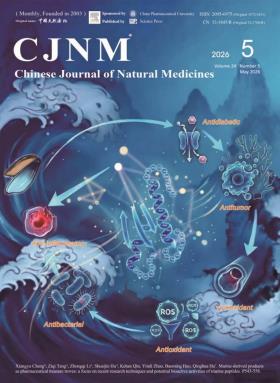
Marine-derived products as pharmaceutical treasure troves: a focus on recent research techniques and potential bioactive activities of marine peptidesXiangyu Cheng, Ziqi Tang, Zhongqi Li, Shuaijie Hu, Kehan Qin, Yindi Zhao, Baoming Hao, Qinghua Hu
Chinese Journal of Natural MedicinesVol.24,No.052026
DOI: 10.1016/S1875-5364(26)61178-8
Abstract
With the intensified exploration of marine resources, marine bioactive peptides have become one of the research focuses in biomedicine, food science, and materials science because of their structural diversity, unique biological activities, and broad application potential. At present, the extraction of marine peptides has expanded beyond conventional chemical extraction and enzymatic hydrolysis, with microbial fermentation and gastrointestinal simulation technologies further broadening peptide diversity. In addition, the integration of multiple chromatographic techniques with advanced detectors has significantly improved the efficiency of marine peptide identification. Owing to their diverse biological activities, including immunoregulatory, antioxidant, antibacterial, antitumor, hypotensive, and hypoglycemic effects, marine peptides not only enrich the pool of candidates for marine drug development but also provide new perspectives for addressing numerous health challenges. Importantly, substantial progress has been made in the screening, identification, and mechanistic elucidation of marine bioactive peptides, driven by advances in high-throughput technologies and the bioinformatics. However, marine peptide research still faces several challenges, including complex sourcing, difficulties in large-scale acquisition, and insufficient exploration of biological activities. Therefore, this article concisely reviews recent progress in the extraction, purification, and identification of marine bioactive peptides, summarizes current research on their biological activities, and highlights the application of bioinformatics in marine peptide studies.
Original Article
Open Access
Yangxinshi Tablet protects against post-myocardial infarction heart failure with reduced ejection fraction by improving energy metabolism through inhibition of FOXO1/PDK4 signalingJingwen Guo, Rong Miao, Qingying Fan, Yilin Li, Yuhua Tian, Aomei Sun, Qingrui Zhang, Zhenguo Lv, Guangwei Qi, Opoku Bonsu Francis, et al.
Chinese Journal of Natural MedicinesVol.24,No.052026
DOI: 10.1016/S1875-5364(26)61119-3
Abstract
Heart failure (HF) is a major contributor to global morbidity and mortality, with myocardial infarction (MI)-induced HF accounting for a substantial proportion of cases. Although Yangxinshi Tablet (YXS) is clinically used, the mechanisms by which it alleviates HF remain unclear. To elucidate the protective mechanisms of YXS in post-MI HF. An MI-induced HF model was established in male Sprague-Dawley rats, and cardiac function, exercise endurance, hemodynamics, serum biochemical indices, and pathological damage were assessed. To investigate the underlying mechanisms, metabolomics, quantitative polymerase chain reaction (qPCR), ribonucleic acid sequencing (RNA-seq), Western blot, immunofluorescence, chromatin-immunoprecipitation (ChIP)-qPCR, and single-cell RNA-seq were employed. The components of YXS were analyzed via molecular docking, and their biological activity was validated in cell-based assays. YXS improved cardiac function and exercise endurance, enhanced hemodynamic parameters, reduced inflammatory cell infiltration, and decreased collagen fiber deposition in vivo. In vitro, YXS regulated mitochondrial energy metabolism and protected against oxygen-glucose deprivation (OGD)-induced cardiomyocyte injury. Notably, YXS ameliorated post-MI HF by inhibiting forkhead box O1 (FOXO1)/pyruvate dehydrogenase kinase 4 (PDK4) signaling, thereby promoting the tricarboxylic acid (TCA) cycle and increasing adenosine 5'-triphosphate (ATP) levels to restore energy metabolism both in vivo and in vitro. Senkyunolide H, apigenin, astragaloside IV, and astragaloside VII were identified as active constituents of YXS using an OGD-induced H9c2 cell injury model. These findings indicate that YXS exerts cardioprotective effects in a rat model of post-MI HF. Mechanistically, YXS inhibits FOXO1/PDK4 signaling, enhances TCA cycle activity, and elevates ATP production to improve cardiac energy metabolism and restore energy homeostasis.
Open Access
Silibinin meglumine ameliorates hepatic encephalopathy via inhibiting UCP2-mediated oxidative stress and mitochondrial dysfunctionYue Li, Hong Chen, Xinyi Chen, Zhangqiu Zhou, Jieman Wang, Yuanyuan Zhang, Shengpeng Zhang, Hongliang He, Junping Kou
Chinese Journal of Natural MedicinesVol.24,No.052026
DOI: 10.1016/S1875-5364(26)61180-6
Abstract
Hepatic encephalopathy (HE) is a severe clinical condition with limited therapeutic options. Silybin, a principal bioactive constituent of milk thistle, is a natural compound known for its protective effects against various liver diseases and neurodegenerative disorders. Silibinin meglumine (SM), the meglumine salt of silybin, is widely used in the management of hepatic disorders. However, the therapeutic potential and mechanistic basis of SM in HE remain incompletely elucidated. In this study, SM reduced serum ammonia levels and improved hepatic function markers, including alanine transaminase, aspartate transaminase, and total bilirubin (TBil), in thioacetamide (TAA)-induced HE mice. SM also attenuated inflammatory cytokines such as tumor necrosis factor (TNF) and interleukin-6 (IL-6) in both plasma and brain tissue, reduced the oxidative stress marker malondialdehyde, and increased glutathione levels. Furthermore, molecular docking, cellular thermal shift assay (CETSA), drug affinity responsive target stability (DARTS) assay, and microscale thermophoresis (MST) assay collectively indicated that uncoupling protein 2 (UCP2) may serve as a direct molecular target of SM in mitigating HE. Notably, SM downregulated UCP2 expression in liver tissue and alleviated oxidative stress and mitochondrial dysfunction through modulation of the UCP2/PINK1/Drp1/mitofusin-2 (MFN2)/LC3B pathway. Additionally, co-administration of a UCP2 inhibitor partially attenuated the antioxidant effects of SM; however, no statistically significant reduction was observed in alanine aminotransferase (ALT) and aspartate aminotransferase (AST). In summary, this study demonstrates that SM-mediated targeting of UCP2 enhances hepatic mitochondrial function and suppresses excessive mitophagy, thereby ameliorating TBil in TAA-induced HE. These findings suggest that SM may represent a promising therapeutic strategy for TAA-induced HE.
Open Access
Penicipenoids A−G, antioxidant and anti-inflammatory cadinane sesquiterpenoids with rearranged carbon skeletons from the marine sponge symbiotic Penicillium sp. 5975Dongdong Xie, Peihai Li, Lu Zhang, Ruyi Shang, Jiaxin Li, Kechun Liu, Houwen Lin, Shuping Wang, Weihua Jiao
Chinese Journal of Natural MedicinesVol.24,No.052026
DOI: 10.1016/S1875-5364(26)61181-8
Abstract
Seven new sesquiterpenes, named penicipenoids A−G (1−7), were isolated from rice-based fermentation cultures of the marine sponge-derived fungus Penicillium sp. 5975, together with ten known analogues (8−17). Their structures were elucidated using high-resolution mass spectrometry (HR-MS) and nuclear magnetic resonance (NMR) spectroscopy, supported by single-crystal X-ray diffraction analysis and electronic circular dichroism (ECD) calculations. Penicipenoid A (1) features an unprecedented sesquiterpene scaffold characterized by a tricyclo[4.4.11,602,7]hendecane core. Penicipenoid D (4) contains an unusual furan substructure within the cadinane-type sesquiterpenoid class, while penicipenoid F (6) represents a rare norsesquiterpene derivative lacking the carbon atom at the C-7 position. The in vivo anti-oxidant and anti-inflammatory effects of these compounds were evaluated using transgenic fluorescent zebrafish models. Penicipenoids A−C (1−3) exhibited anti-oxidant activity in metronidazole (MTZ)-treated transgenic zebrafish embryos, whereas penicipenoid E (5) demonstrated potent anti-inflammatory activity in CuSO4-induced transgenic fluorescent zebrafish embryos.
CURRENT ISSUE
Download Cover(PDF) Download TOC(PDF)
