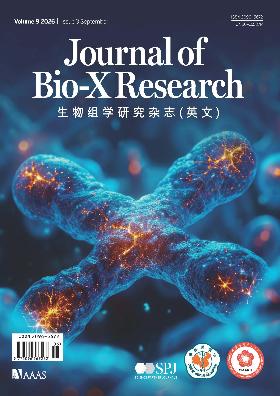
Journal of Bio-X Research

Journal of Bio-X Research
Instructions for Authors
The Editorial Office is pleased to answer any questions you may have about preparing your manuscript in accordance with our guidelines.
Email: qinwei@jbioxresearch.org
Aims and scope
Journal of Bio-X Research is an international Open Access journal devoted to publishing peer-reviewed, high quality, original papers in a variety of fields at the cross boundaries between biology and medicine. The journal focuses on the development and application of cutting-edge methods in genomics, transcriptomics, proteomics and other “omics”. It provides the most comprehensive coverage in interdisciplinary research, spanning significant technical developments and applications of “omics” platforms in every area of etiology, pathophysiology, clinical treatment, and prevention of complex diseases. It publishes scientific investigation of the highest quality in the broad field of complex diseases, such as tumor, diabetes, hypertension, and soon.
Online submission
All manuscripts must be submitted online at: http://www.editorialmanager.com/jbioxresearch
First-time users
Please click the Register button at http://www.editorialmanager.com/jbioxresearch. Upon successful registration, you will be sent an email providing your username and password. Save this information for future reference. Note: If you have received an email from us with an assigned username and password, or if you are a repeat user, you do not have to re-register.
Authors
Please click the Login button from the menu at the top of the page and login to the system as an author. Submit your manuscript according to the instructions for authors. You will be able to track the process of your manuscript through the system.
Journal policies
Duplicate Publication
Manuscripts are reviewed for possible publication with the understanding that they are being submitted only to Journal of Bio-X Research and have not been published, simultaneously submitted, or already accepted for publication elsewhere. The Editorial team will subject all manuscripts submitted for consideration of publication in Journal of Bio-X Research to plagiarism-detection software.
This does not preclude consideration of a manuscript that has been rejected by another journal or a complete report that follows publication of preliminary findings elsewhere, usually in the form of an abstract. Copies of any possibly duplicate published material should be submitted with the manuscript under consideration, with a statement in the cover letter as to why the manuscript currently being submitted is not a duplicate publication.
Disclosure of Conflicts
Authors must state all possible conflicts of interest in the manuscript, including financial, consultant, institutional and other relationships that might lead to bias or a conflict of interest. If there is no conflict of interest, this should also be explicitly stated as none declared. All sources of funding should be acknowledged in the manuscript. All relevant conflicts of interest and sources of funding should be included on the title page of the manuscript with the heading "Conflicts of Interest and Source of Funding:" For example: “Conflicts of Interest and Source of Funding: A has received honoraria from Company Z. B is currently receiving a grant (#12345) from Organization Y, and is on the speaker's bureau for Organization X - the CME organizers for Company A. For the remaining authors, no relevant conflicts of interest were declared.”
Authorship
Journal of Bio-X Research expects that each person listed as an author has participated sufficiently in the intellectual content, the analysis of data, and/or the writing of the manuscript to take public responsibility for it. Each author must have reviewed the manuscript, believes it represents valid work, and approves it for submission.
Moreover, should the Editorial team request the data upon which the manuscript is based, the authors shall provide the data. Each author’s specific contributions to the work should be indicated; this information will be published as a footnote to the paper. For example, the areas of participation might include:
-
Participated in research design
-
Participated in the writing of the paper
-
Participated in the performance of the research
-
Contributed new reagents or analytic tools
-
Participated in data analysis
An author may list more than one contribution, and more than one author may have contributed to the same aspect of the work. Any change in authorship/contributions after submission must be approved in writing by all authors and submitted to the Editorial Office for final consideration.
Appropriate use of the English language is a requirement for publication in Journal of Bio-X Research. Authors who have difficulty in writing in English who submit manuscripts to international journals often receive negative comments from referees or editors about the English-language usage in their manuscripts, and these challenges can contribute to a decision to reject a paper. To help reducing the possibility of such problems, we strongly encourage authors to consider using Wolters Kluwer Author Services**.
Wolters Kluwer, in partnership with Editage, offers a unique range of editorial services to help you prepare a submission-ready manuscript:
-
Premium Editing: Intensive language and structural editing of academic papers to increase changes of journal acceptance.
-
Advanced Editing: A complete language, grammar, and terminology check to give you a publication-ready manuscript.
-
Translation with Editing: Write your paper in your native language and Wolters Kluwer Author Services will translate it into English, as well as edit it to ensure that it meets international publication standards.
-
Plagiarism Check: Helps ensure that your manuscript contains no instances of unintentional plagiarism.
-
Artwork Preparation: Save precious time and effort by ensuring that your artwork is viewed favorably by the journal without you having to incur the additional cost of purchasing special graphics software.
For more information regarding Wolters Kluwer Author Services, please visit:
http://wkauthorservices.editage.com.
**Note that the use of such a service is at the author’s own expense and risk, and does not guarantee that the article will be accepted.
Reporting of Randomized Clinical Trials
Registration of Clinical Trials is an essential requirement for publication of clinical trials in Journal of Bio-X Research. On the title page of your manuscript, provide the name of the trial registry and the registration number/identifier of the trial.
Acceptable web-based clinical trial registries include the following:
-
EudraCT for EU trials
-
Clinical Trials for US trials
-
And any publicly available primary registry of clinical trials
Reports of randomized clinical trials should follow the recommendations given in the Consolidated Standards of Reported Trials (CONSORT) statement. In brief, this statement comprises a checklist and flow diagram to help improve the quality of reports of randomized controlled trials and offers a standard way for researchers to report trials.
Other Reporting Guidelines
The following guidelines need to be followed by authors:
-
PRISMA –Preferred Reporting Items for Systematic Reviews and Meta-Analyses
-
STROBE - Strengthening the Reporting of Observational studies in Epidemiology
-
CARE - Strengthening the reporting of Clinical Case Report
Qualitative Research
Qualitative research provides in-depth insights on people’s values, attitudes, beliefs, and experiences. Qualitative methodology informs approaches to data collection and analysis, and includes grounded theory, ethnography, and phenomenology. Open-ended interviews and focus groups are commonly used to collect data. Authors are advised to follow the COREQ guidelines for reporting primary qualitative research.
Systematic review and/or synthesis of primary qualitative studies can provide a broader understanding of people’s perspectives across different healthcare contexts. Methodologies for synthesis of qualitative research include thematic synthesis, meta-ethnography and critical interpretive synthesis. Authors can refer to the ENTREQ statement.
Financial Support and Competing Interests
A financial disclosure section is part of the submission process and must be completed by each author at submission. This information is for review by the Editors but will be published if relevant to the content of the accepted manuscript.
The primary purpose of the disclosure section is to determine whether authors have received any commercial financial support that could create a conflict of interest. In addition to monetary interests, a potential for conflict of interest can exist whether or not an individual believes that a relationship (such as dual commitments, competing interests, or competing loyalties) affects his or her scientific judgment. Please review ICMJE Uniform Requirements for Manuscripts
Ethics
When reporting studies on human beings, author should indicate whether the procedures followed were in accordance with the ethical standards of the responsible committee on human experimentation (institutional or regional) and with the Helsinki Declaration. For prospective studies involving human participants, authors are expected to mention about approval of regional/national/institutional or independent ethics committee or review board, obtaining informed consent from adult research participants and obtaining assent for children aged over 7 years participating in the trial. The age beyond which assent would be required could vary as per regional and/or national guidelines. Ensure confidentiality of subjects by desisting from mentioning participants’ names, initials or hospital numbers, especially in illustrative material. When reporting experiments on animals, indicate whether the institution’s or a national research council’s guide for, or any national law on the care and use of laboratory animals was followed.
Evidence for approval by a local ethics committee (for both human as well as animal studies) must be supplied by the authors on demand. Animal experimental procedures should be as humane as possible and the details of anesthetics and analgesics used should be clearly stated. The ethical standards of experiments must be in accordance with the guidelines provided by the CPCSEA and World Medical Association Declaration of Helsinki on Ethical Principles for Medical Research Involving Humans for studies involving experimental animals and human beings, respectively. The journal will not consider any paper which is ethically unacceptable. A statement on ethics committee permission and ethical practices must be included in all research articles under the “Methods” section.
Protection of Patients’ Rights to Privacy
Identifying information should not be published in written descriptions, photographs, sonograms, CT scans, etc., and pedigrees unless the information is essential for scientific purposes and the patient (or parent or guardian, wherever applicable) gives written informed consent for publication. Authors should remove patients’ names from figures unless they have obtained written informed consent from the patients. The journal abides by ICMJE guidelines: (1) Authors, not the journals nor the publisher, need to have the patient consent form before the publication related to patient privacy and have the form properly archived by the author. (2) If the publication includes some facial images that make the patients identifiable, a statement about the patient’s consent needs to be present in the manuscript.
Peer Review
Journal of Bio-X Research operates a double-blind external peer review process, wherein the reviewers and authors are unaware of each other’s identity. Brief introduction on editorial review process of the journal:
On submission, editors review all submitted manuscripts initially for suitability for formal review. Manuscripts with insufficient originality, serious scientific or technical flaws, or lack of a significant message are rejected before proceeding for formal peer-review. Manuscripts that are unlikely to be of interest to the readers of the journal are also liable to be rejected at this stage.
Manuscripts that are found suitable for potential publication of the journal are sent to a minimum of two independent expert reviewers to assess the scientific quality of the manuscript. Authors submitting manuscripts to the journal may propose suitable reviewers or oppose reviewers who may have competing interests. The proposed reviewers should not be affiliated with the same institutes as the contributor(s). However, the selection of these reviewers is at the sole discretion of the editor, who selects reviewers to reflect relevant expertise, diversity, and geographical backgrounds.
Peer reviewers have access to the submitted manuscript and any appendices included by the authors. If the paper is a randomized controlled trial, peer reviewers will also have access to the trial protocol. Peer review assists editors in their decision on whether to publish an article and helps authors revise and improve their manuscripts. Peer reviewers make suggestions for improvements, critique the analysis, point out relevant published work which is not yet cited, and provide recommendations to the authors and the editors. At Journal of Bio-X Research, reviewers are not aware of authors’ identities, meantime, reviewers’ comments are sent to the authors anonymously. Details of peer review including dates and peer review comments are not shared publicly. Reviewed articles are treated confidentially prior to their publication.
Based on the comments from the reviewers, the handling editor takes an acceptance decision on the manuscript and convey the comments and suggestions (acceptance/ rejection/ amendments in manuscript) to the corresponding author, who is requested to provide a point by point response to reviewers’ comments and submit a revised version of the manuscript. This process is repeated until reviewers and editors are satisfied with the manuscript. Manuscripts are accepted on the basis of quality, originality, significance, novelty and importance for the field.
The authors do have the right to appeal if they have a genuine cause to believe that the editorial board has wrongly rejected the paper. If the authors wish to appeal the decision, they should email the editorial office (email: qinwei@jbioxresearch.org) explaining in detail the reason for the appeal. The appeals will be acknowledged by the editorial office and will be investigated in an unbiased manner. The processing of appeals will be done within 6–8 weeks. While under appeal, the said manuscript should not be submitted to other journals. The final decision rests with the Editor-in-Chief of the journal. Second appeals are not considered.
Manuscripts received from Editorial Board Members will be screened by the Editor-in-Chief and sent to external peer reviewers. In case, Editor-in-Chief is the author, then the article will be screened by Assistant Editor/Co-Editor-in-Chief and sent to external peer reviewers. The Editorial Board Members who are authors will be excluded from publication decisions.
Editors are not involved in decisions about papers which they have written themselves or have been written by family members or colleagues or whoever relate to products or services in which the editor has an interest. Any such submission is subject to the journal’s standard procedures, with peer review handled independently of the relevant editor and their research groups.
Gene Nomenclature
Authors should use approved gene nomenclature where available. Authors proposing a new gene nomenclature should contact the HUGO Gene Nomenclature Committee.
For human genes, please use symbols approved by the HUGO Gene Nomenclature Committee (HGNC). HGNC nomenclature can be queried. The species listed below all have gene nomenclature committees. Please use the nomenclature they have approved by searching for gene symbols at the following links:
Mouse
Rat
Gene symbols and names in all other mammals (and usually all vertebrates) should follow the same nomenclature as the human gene.
It can be difficult for readers to determine whether authors are referring to a gene or its corresponding protein, therefore it is important to use accepted conventions for gene and protein symbols. Symbols for genes should be italicized (IGF1), whereas symbols for proteins are not italicized (IGF1). Gene names that are written out in full are not italicized (insulin-like growth factor 1).
Authors should check each gene/protein name and symbol in their paper even if it has been published previously. Genes and their corresponding proteins often have different names and symbols and sometimes you may find that the approved gene/protein name or symbol has been updated. Journal of Bio-X Research prefers that the same symbol is used for genes and proteins; however, where proteins are more widely known by an alternative name/symbol, then the encoding gene, where possible, should be referred to e.g. ‘TRAIL (encoded by TNFSF10)’. Synonyms can be referred to using ‘also known as’ or ‘previously known as’ e.g. TARDBP (previously known as TDP-43). Thereafter, use the current approved symbol and not the previous designation.
Journal of Bio-X Research allows the use of gene symbols in the abstract and headings. Gene symbols do not need to be defined in the abbreviations list. For clarity, it is best to be consistent in the use of either the full gene name, or the symbol throughout the text, but use of either is acceptable.
Types of Manuscripts Published
|
Type |
Text* Word count |
Abstract Word count |
Figures/Tables |
References |
Supplement possible |
|
Research Article |
5000 |
400, structured |
10 |
50 |
Yes |
|
Review Article |
5000 |
250, unstructured |
10 |
100 |
No |
|
Comment |
1000 |
No abstract |
1 |
10 |
No |
|
Editorial |
1500 |
No abstract |
1 |
10 |
No |
*Text word count excludes abstract, figure legends, and references. Please ensure that the text word count is included on the Title page of the manuscript.
Articles are full-length reports of completed basic, translational or clinical research. Articles should report important, novel and fully completed studies with strong conclusions. There is a maximum length of 5000 words, but shorter articles can also be considered, as long as these are fully completed studies. Preliminary reports cannot be accepted. Articles have a structured abstract of maximum 400 words, including Objective, Methods, Results and Conclusion.
Review Articles are invited articles. Suggestions can be sent to the editors using the editorial office’s email: qinwei@jbioxresearch.org. Review Articles have an unstructured abstract of maximum 250 words and a word count of approximately 5000 words. Review articles should not simply summarize information, but also discuss the importance and impact of the data providing a clear view on how these insights have transformed or will transform the field. Authors of review articles are encouraged to include several figures and tables to summarize and visualize data.
Comments are short discussions to be used to describe an own opinion on recently published data in Journal of Bio-X Research. The authors of the original publication will be contacted for a response, which if accepted, will be published in the same issue as the ‘Comment’. Comments have no abstract and should cite the article under discussion.
Editorials are invited articles to explain the importance of specific articles or to provide opinions on general concepts in practice, research or policy. Editorials have no abstract and are typically 1000 to 1500 words long. Editorials who discuss a recently published article should cite that article as the first reference.
MANUSCRIPT PREPARATION AND FORMATTING INSTRUCTIONS
Manuscripts must be written in clear, grammatical English (see English Language Assistance above). Manuscripts not conforming to Journal format will be returned to authors for modification. Please double space the entire main body document and number each page. Do not add line numbers as the system will generate those when the PDF is built.
Footnotes, abbreviations, and abstract pages must be included in the main body file. Please do not upload separate copies of these documents, only the Title page must be a separate file and uploaded separately to the main body file.
Acceptable document file types for text and tables include .DOC and .DOCX; do not submit a PDF.
Title Page.
The following elements are required for every submission:
Title. Include a descriptive title of the work; the title should not be a sentence. No proprietary or brand names for drugs or agents may be used in article titles.
Authors. The full first name, middle initials, and family name of each author, as well as the name(s) of the department(s) and institution(s) to which the work should be attributed.
Address for Correspondence. A current email and full mailing address for the corresponding author must be provided.
Funding. Include disclosure of funding received for this work, especially details of funding from any of the following organizations: National Institutes of Health (NIH); Wellcome Trust; and Howard Hughes Medical Institute (HHMI).
Disclosure. If the author(s) have no funding to disclose, please include the phrase, “The authors declare no conflicts of interest.”
Author contributions and potential conflicts of interest: List each author’s specific contributions to the work (see details above, under (Authorship) and list all forms of support received by each author for this study; list any potential conflict of interest for each author, or make a declaration of no conflict of interest.
Following pages.
Abstract. Where required, abstracts are limited to 250 words, which is excluded from the overall manuscript word count. The abstract is structured including Objective, Methods, Results and Conclusion, and should briefly describe: (1) the problem being addressed in the study, (2) how the study was performed, (3) the salient results, and (4) what the authors conclude from the results.
Keywords. 5 key words are required. Please note that key words should not be the same as words used in the title.
Introduction. The introduction contains a statement of the purpose of the work, the problem that stimulated it, and a brief summary of relevant published investigations.
Results. The results should be concise, avoiding redundant tables and figures illustrating the same data.
Discussion. This section should follow the results and is used to interpret results, with minimal recapitulation of findings.
Materials and Methods. Avoid detailed description of previously published methods and cite the appropriate reference. Detailed methods may be provided as Supplementary information.
Acknowledgments. Acknowledgments should be used to identify all funding sources and may also be used to note intellectual, technical, or other assistance that does not warrant authorship. Acknowledged individuals should be informed before the publication and be given the opportunity to decline the recognition.
Author contributions. Contributors should provide a description of contributions made by each of them towards the manuscript. Description should be divided into following categories, as applicable: concept, design, definition of intellectual content, literature search, clinical studies, experimental studies, data acquisition, data analysis, statistical analysis, manuscript preparation, manuscript editing, and manuscript review. One author should take responsibility for the integrity of the work as a whole from inception to published article and should be designated as “corresponding author”.
Financial support. Any funds used to support the research of the manuscript should be placed.
Institutional review board statement. A statement on ethics committee permission (including approval number and date (dd/mm/yy)).
References. References should begin on a separate page and numbered in the order in which they are cited in the text, where they are designated by superscript numbers placed outside periods and commas, and inside colons and semicolons. Only published works and manuscripts that have been accepted for publication should be listed in the References. Manuscripts in preparation, unpublished observations, and personal communications should be referred to in parentheses in the text. Over 50% of cited references have been published within the preceding 5 years are required.
References Format. No more than three authors should be listed. If there are four or more, only the first three followed by ‘‘et al.’’ should be included. Titles of journal articles must be included, and abbreviation of journal names should conform to Index Medicus style. For example, CSCs, like normal pluripotent stem cells, have the ability to self-renew and differentiate into various types of cells.[19]
Journal article:
No more than three authors:
Dutta R, Mahato RI. Recent advances in hepatocellular carcinoma therapy. Pharmacol Ther 2017;173:106–117.
More than three authors:
Bray F, Ferlay J, Soerjomataram I, et al. Global cancer statistics 2018: GLOBOCAN estimates of incidence and mortality worldwide for 36 cancers in 185 countries. CA Cancer J Clin 2018;68:394–424.
Book:
Costa DC, Morgan GF, Lassen NA, eds. New trends in neurology and psychiatry. John Libbey; 1993.
Book chapter:
Barkovich AJ. Disorders of neuronal migration and organization. In: Kuzniecky RI, Jackson GD, eds. Magnetic resonance in epilepsy. Raven Press; 1994:235-255.
Conference proceedings:
Hou Y, Qiu Y, Vo NH, et al. 23-O derivatives of OMT: highly active against H. influenzae. In: Programs and Abstracts of the Forty-third Interscience Conference on Antimicrobial Agents and Chemotherapy. Chicago; 2003. Abstract F-1187. American Society for Microbiology. 242-247.
Website:
Alzheimer’s Disease Neuroimaging Initiative. http://adni.loni.usc.edu/methods/research-tools/. Accessed 11 November 2020.
Organization:
CDC. Prevention of herpes zoster: recommendations of the Advisory Committee on Immunization Practices (ACIP). MMWR Recomm Rep 2008; 57: 1.
Donation after Circulatory Death. British Transplant Society Accessed August 1, 2013.
Tables. Photographs of tables are not acceptable. Type each table, 1.5 spacing throughout (including column headings, footnotes, and data), on a separate page. Tables may be included as part of the Main Body file and placed after the References section. Number the tables in sequence in Arabic numerals and supply a concise, informative title for each one. Each column in the tables should carry a concise heading describing the data in the column. Use lowercase superscript letters to designate footnotes, and type the footnotes below the tables to which they refer. Tables are cited in the text in numerical order. Each table should be able to be understood without consulting the text.
Like text, tables should be prepared using a standard word-processing program and may be included within the main body text document, or uploaded separately. Do not upload table files more than once (that is, in the main document and in separate files). Acceptable document file types for tables include .DOC and .DOCX; do not submit PDF, XLS or XLSX type files.
Figures and Legends. Figures should be uploaded in the highest resolution available. Legends should be supplied for all figures. They are numbered to correspond with the figures and typed double-spaced on a separate page. Figure legends for any supplemental figures being submitted are to be provided separately; see section, Supplemental Digital Content (SDC).
Acceptable figure file formats
-
Do not embed figures into the main body file
-
All final digital figures for accepted manuscripts must be submitted in EPS, TIFF, JPG.
-
Each figure must be uploaded as a separate file.
-
Histology figures must be in color.
-
Monochrome images (such as line graphs) should be prepared at a resolution of 1200 DPI.
-
Halftones images (black/white or color) should be prepared at a resolution of 300 DPI.
-
Combination halftones (images containing both pictures and text labeling) should be prepared at 600 DPI.
-
Color images must be saved as ‘‘CMYK’’. Images saved as ‘‘RGB’’ are not acceptable for printing.
-
Your manuscript may be returned to you for correction if the images are of insufficient quality.
-
Artwork submitted to the Journal will be checked for quality. Authors submitting a revised paper will have the opportunity to check the quality of their images and make the necessary changes. This step is required for all revisions.
Supplemental Digital Content (SDC): Authors may submit Supplemental Digital Content to supplement the information provided in the manuscript. It is preferable to include all significant figures and tables in the manuscript, since there is not a limit on the number of items in this online journal. Nonetheless, SDC may include the following types of content: text, tables, figures, references peripheral to information provided as SDC, audio, and video. SDC should be consecutively cited in the Main Body text of the submitted manuscript. SDC files will be available via url(/s) placed at the citation points within the article and are not copyedited by the publisher. Note that Journal policies for manuscript submission relating to peer review, patient anonymity, ethics, financial disclosure, copyright, and permissions also apply to SDC. Authors should mask patients’ eyes and remove patients’ names from supplemental digital content unless they obtain written consent from the patients and submit them as supplemental files at the time of the manuscript submission.
Format, File Type and Size Requirements: SDC must be provided in one Word or PowerPoint file. Each SDC in the file should have a visual header in the following name format (e.g., ‘‘SDC, Figure 1’’; ‘‘SDC, Materials and Methods’’) and a corresponding citation must appear in the Main Body text. Note that SDC is numbered separately from non-SDC material. If providing SDC figure(s), a figure legend should be included on the figure itself. When uploading SDC select ‘‘Supplemental Digital Content’’ as the file designation. For audio and video files, also include the author name, videographer, participants, length (minutes), and size (MB). Video files should be formatted with a 320x240 pixel minimum screen size. For each submission, the SDC file cannot exceed a total size of 10 MB.
Online manuscript submission
New Submissions
Once the manuscript has been created, visit the submission site at http://www.editorialmanager.com/jbioxresearch to upload the manuscript. Once the manuscript has been vetted for compliance to the Journal’s requirements, a manuscript number will be assigned to the submission. Failure to adhere to these guidelines will result in your manuscript being returned to you for correction. Faxed, scanned or emailed copies of manuscripts will not be accepted.
Revised Submissions
All revised submissions require a point-by-point response to the reviewers’ comments. Please upload this document as file type Response to Reviewers.
Changes made in the revised manuscript should be indicated using highlighted, bold or underlined text. Upload both a Marked and a Clean (Unmarked) version of the revised manuscript. File types are provided for both versions.
A requirement of all revisions is the artwork quality check as described above (see Figures and Legends).
Revised manuscripts should be submitted within the deadline specified in the decision letter. Please contact us for an extension of the due date if it is not possible to submit the revision within that period, or should you desire to withdraw the manuscript from further consideration.
Revisions should adhere to original specifications for the submission type. Sometimes changes made in response to the decision/critiques may bring the revised manuscript out of compliance (e.g., over the word count and/or table/figure limit) with original specifications. This may be allowed by the Editor, but must be noted in the point-by-point response.
Submitting Invited Videos
Authors may want or be invited to submit videos to the Journal’s website. The videos will serve to emphasize key aspects of the research findings reported in their soon to be published manuscript. Please visit Stand Alone Video Format Requirements to download full specifications and instructions for preparing these invited videos.
Mandatory Author Forms
Upon acceptance of an article, authors will be asked to complete a 'Journal Copyright Agreement' form. An e-mail will be sent to the corresponding author confirming receipt of the manuscript together with a 'Journal Publishing Copyright Agreement' form or a link to the online version of this agreement.
Post acceptance
Page Proofs
The publisher’s Journal Production Editor will contact you when page proofs are ready for your review. Please inform the Journal Production Editor immediately if you have any questions concerning the quality of the figures on the proofs. For information regarding proofs, or the status of publication of your accepted manuscript, please contact Naomi Ullman (naomi.ullman@wolterskluwer.com).
Changes at Proofs
It is expected that the final manuscript sent to the Editor is indeed the final version, so few changes should be required at proof stage.
Copyright
The Chinese Medical Association (CMA) is the owner of all copyrights to any articles published in the journal. Published manuscripts become the permanent property of CMA and may not be published elsewhere without written permission. CMA keeps the right to use these manuscripts in any form, including print, video, audio and digital.
Open Access
Every peer-reviewed research article appearing in this journal will be published open access. This means that the article is universally and freely accessible via the internet in perpetuity, in an easily readable format immediately after publication. The journal does not charge for submission, processing or publication of manuscripts and even for color reproduction of photographs. The Chinese Medical Association will pay to make the article open access.
A CC user license manages the reuse of the article (see http://www.wkopenhealth.com/openaccessfaq.php). All articles will be published under the following license:
Creative Commons Attribution-NonCommercial-NoDerivs (CC BY-NC-ND)
For non-commercial purposes, lets others distribute and copy the article, and to include in a collective work (such as an anthology), as long as they credit the author(s) and provided they do not alter or modify the article.
Editorial Office Contacts
The Editorial Office is pleased to answer any questions you may have about preparing your manuscript in accordance with our guidelines.
Email:
Wei QIN
BIO-X Institutes, Shanghai Jiao Tong University
Little White House, 1954 Huashan Road, Shanghai, 200030, China?
qinwei@jbioxresearch.org
Submit a manuscript: http://www.editorialmanager.com/jbioxresearch
CURRENT ISSUE