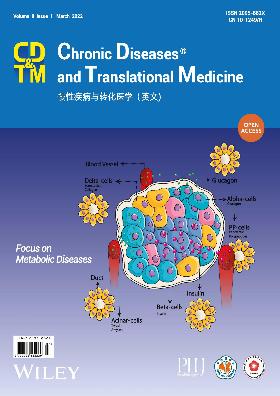
Chronic Diseases and Translational Medicine
Volume 08 · Issue 01 · 2022
Chron Dis Transl Med
- Sections
- Editorial Commentary
- Review
- Original Article
糖尿病的患病率急剧增加,全世界有超过5.37亿成年人受到影响。
非酒精性脂肪性肝病(NAFLD)是以肝脏脂肪变性为特征的临床病理综合征,排除酒精等明确的肝损害因素,包括NAFL、非酒精性脂肪性肝炎(NASH)、肝纤维化、肝硬化,甚至肝癌。NAFLD可从NAFL进展为NASH,然后进展为肝硬化、肝癌,
Fibroblast growth factor 21 (FGF21) is a fasting or stress inducible metabolic hormone produced mainly in the liver. It plays important roles in regulating both glucose and lipid homeostasis via interacting with a heterodimeric receptor complex comprising FGF receptor 1 (FGFR1) and β-klotho (KLB). For the past decade, great effort has been made on developing FGF21 derivatives or specific FGF21 receptor agonists into therapeutic agents for various metabolic disorders including type 2 diabetes (T2D), obesity, and more importantly, nonalcoholic fatty liver disease (NAFLD). Here we have reviewed FGF21 gene and protein structures, its expression pattern, cellular signaling cascades that mediate FGF21 production and function. We have then summarized the six clinical trials utilizing four FGF21 analogues. Finally, two recent literatures on the development of GLP-1 and FGF21 dual agonists were presented briefly.
In the past decades, there have been numerous advancements in the field of technology. This has led to many scientific breakthroughs in the field of medical sciences. In this, rapidly transforming world we are having a difficult time and the problem of fatigue is becoming prevalent. So, this study aimed to understand what is fatigue, its repercussions, and techniques to detect it using machine learning (ML) approaches. This paper introduces, discusses methods and recent advancements in the field of fatigue detection. Further, we categorized the methods that can be used to detect fatigue into four diverse groups, that is, mathematical models, rule-based implementation, ML, and deep learning. This study presents, compares, and contrasts various algorithms to find the most promising approach that can be used for the detection of fatigue. Finally, the paper discusses the possible areas for improvement.
Glucagon is a potent glucose-elevating hormone that is secreted by pancreatic α- cells. While well-controlled glucagon secretion plays an important role in maintaining systemic glucose homeostasis and preventing hypoglycaemia, it is increasingly apparent that defects in the regulation of glucagon secretion contribute to impaired counter-regulation and hyperglycaemia in diabetes. It has therefore been proposed that pharmacological interventions targeting glucagon secretion/signalling can have great potential in improving glycaemic control of patients with diabetes. However, despite decades of research, a consensus on the precise mechanisms of glucose regulation of glucagon secretion is yet to be reached. Second messengers are a group of small intracellular molecules that relay extracellular signals to the intracellular signalling cascade, modulating cellular functions. There is a growing body of evidence that second messengers, such as cAMP and Ca2+, play critical roles in α-cell glucose-sensing and glucagon secretion. In this review, we discuss the impact of second messengers on α-cell electrical activity, intracellular Ca2+ dynamics and cell exocytosis. We highlight the possibility that the interaction between different second messengers may play a key role in the glucose-regulation of glucagon secretion.
The most common etiologies of Cushing's syndrome (CS) are adrenocorticotropic hormone (ACTH)-producing pituitary adenoma (pitCS) and primary adrenal gland disease (adrCS), both of which burden patients with metabolic disturbance. The aim of this study was to compare the metabolic features of pitCS and adrCS patients.
A retrospective review including 114 patients (64 adrCS and 50 pitCS) diagnosed with CS in 2009-2019 was performed. Metabolic factors were then compared between pitCS and adrCS groups.
Regarding sex, females suffered both adrCs (92.2%) and pitCS (88.0%) more frequently than males. Regarding age, patients with pitCS were diagnosed at a younger age (35.40 ± 11.94 vs. 39.65 ± 11.37 years, p = 0.056) than those with adrCS, although the difference was not statistically significant. Moreover, pitCS patients had much higher ACTH levels and more serious occurrences of hypercortisolemia at all time points (8 AM, 4 PM, 12 AM) than that in adrCS patients. Conversely, indexes, including body weight, BMI, blood pressure, serum total cholesterol, low density lipoprotein cholesterol (LDL-C), high density lipoprotein cholesterol (HDL-C), triglycerides, fasting plasma glucose, and uric acid, showed no differences between adrCS and pitCS patients. Furthermore, diabetes prevalence was higher in pitCS patients than in adrCS patients; however, there were no significant differences in hypertension or dyslipidemia prevalence between the two.
Although adrCS and pitCS had different pathogenetic mechanisms, different severities of hypercortisolemia, and different diabetes prevalences, both etiologies had similar metabolic characteristics.
Osteoarthritis (ΟΑ) is characterized by cartilage breakdown and subchondral sclerosis. Micro-fractures of the calcified tissues have been, also, detected, but their exact role has not been elucidated yet. This study was to examine the frequency of cracks during OA progression and to correlate them with the underlying cellular modifications and matrix metalloproteinase-2 (MMP-2) expression using histological/immunohistological methods.
Overall, 20 patients and 3 controls (9 specimens per patient), aged 60-89 years, diagnosed with hip/knee OA were included. The development of cracks was examined in 138 sections, whereas the expression of MMP-2 was examined in 69 additional sections.
Based on Mankin score, three groups of OA severity were analyzed: Group I (mild) was constituted of sections with score 1-5 while Groups II (moderate) and III (severe) with score 6-7 and greater or equal to 8, respectively. Demographic characteristics did not reveal any association between the number of microdefects and age or body mass index (BMI). Cartilage micro-cracks were increased during moderate and severe OA, while bone cracks were increased during mild and severe OA. In knee OA, cartilage cracks were not correlated with Mankin score, whereas in hip OA they appeared association with severity score. Bone cracks were positively correlated with matrix apoptotic osteocytes and osteoblastic cells, but not with osteoclasts. MMP-2 immunostaining was increasing by OA severity in the osteochondral unit. Similarly, MMP-2 was expressed on the microcracks’ wall mainly in Group III.
Our data displayed that bone cracks during primary OA stages, represent an early adaptative mechanism aiming to maintain cartilage integrity. Accumulation of bone defects and concomitant increase of apoptotic osteocytes activated an abnormal remodeling due to osteoblastic activity, in which MMP-2 played a pivotal role, leading to subchondral sclerosis promoting further osteochondral deformities.
Chronic total occlusion (CTO) is a critical and unique subgroup of coronary lesions. This study aimed to investigate the correlation between the Selvester QRS score and late gadolinium enhancement cardiac magnetic resonance imaging (LGE-CMRI) in quantifying myocardial scarring to provide a simple and feasible method for treating CTO.
The medical records of 134 patients with absolute CTO who underwent coronary angiography between May 1, 2014 and December 30, 2017 were retrospectively reviewed. All patients were grouped according to the CTO location (right coronary artery [RCA] CTO, left artery descending [LAD] CTO, left circumflex [LCX] CTO, and multivessel CTO groups). The degree of myocardial scarring was determined according to the Selvester QRS score and using the LGE-CMRI. All patients were followed up for at least 12 months.
Among the 62 CTO patients, 55 had occlusion of a single vessel and seven had occlusion of multiple vessels, of which 27 (43.55%) were in the RCA CTO group, 16 (25.81%) in the LAD CTO group, 12 (19.35%) in the LCX CTO group, and 7 (11.29%) in the multivessel CTO group. The area under the receiver operating characteristic curve for the QRS score that was used to determine the degree of myocardial scarring was 0.806, with a sensitivity and specificity of 94.7% and 42.1%, respectively. The Selvester QRS score and LGE-CMRI measures of scar size were correlated in the RCA CTO, LCX CTO, and multivessel CTO groups (r = 0.466, 0.593, and 0.775, respectively).
The Selvester QRS score was feasible for detecting myocardial scarring in patients with CTO.
Erythropoietin is a glycoprotein that mainly regulates erythropoiesis. In patients with chronic renal failure with anemia, darbepoetin alfa can stimulate erythropoiesis, correct anemia, and maintain hemoglobin levels. This study was designed to demonstrate the efficacy and safety of darbepoetin alfa injections as being not inferior to epoetin alfa injections (Recombinant Human Erythropoietin injection, rHuEPO) when maintaining hemoglobin (Hb) levels within the target range (10.0-12.0 g/dL) for the treatment of renal anemia.
Ninety-five patients were enrolled in this study from April 15, 2013 to April 10, 2014 at 25 sites. In this study, patients (n = 95) aged 18-70 years were randomized into a once per week intravenous darbepoetin alfa group (n = 56) and a twice or three times per week intravenous epoetin alfa group (n = 39) for 28 weeks, who had anemia with hemoglobin levels between 6 g/dL and 10 g/dL due to chronic kidney disease (CKD) and were undergoing hemodialysis or hemofiltration with ESA-naive (erythropoiesis stimulating agent-naive). The primary efficacy profile was the mean Hb level (the non-inferiority margin was -1.0 g/dL, week 21-28); the secondary efficacy profiles were the Hb increase rate (week 0-4), the target Hb achievement cumulative rate and time, the change trends of the Hb levels, and the target Hb maintenance ratio. Adverse events (AEs) were observed and compared, and the efficacy and safety were analyzed between the two treatment groups. Additionally, the frequencies of dose adjustments between the darbepoetin alfa and epoetin alfa groups were compared during the treatment period. SAS® software version 9.2 was used to perform all statistical analyses. Descriptive statistics were used for all efficacy, safety, and demographic variable analyses, including for the primary efficacy indicators.
The mean Hb level was 11.3 g/dL in the darbepoetin alfa group and 10.7 g/dL in the epoetin alfa group, respectively; the difference of the lower limits of the 95% confidence intervals (CI) between the two groups was 0.1 g/dL (>-1.0 g/dL), and non-inferiority was proven; the Hb levels started to increase in the first four weeks at a similar increase rate; no obvious differences were observed between the groups in the target Hb achievement cumulative rates, and the Hb levels as well as the target Hb level maintenance rate changed over time. The incidence of AEs was 62.5% in the darbepoetin alfa group and 76.9% in the epoetin alfa group. All the adverse events observed in the study were those commonly associated with hemodialysis.
Darbepoetin alfa intravenously once per week can effectively increase Hb levels and maintain the target Hb levels well, which makes it not inferior to epoetin alfa intravenously twice or three times per week. Darbepoetin alfa shows an efficacy and safety comparable to epoetin alfa for the treatment of renal anemia.
CURRENT ISSUE