

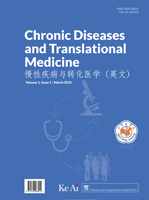
Chronic Diseases and Translational Medicine
Volume 06 · Issue 01 · 2020
Published: March 25, 2020
Chron Dis Transl Med
Review
Open Access
New advances in the diagnosis of primary aldosteronismHang Shen, Zhi-Xin Xu, Qi-Fu Li
Chronic Diseases and Translational MedicineVol.06,No.012020
DOI: 10.1016/j.cdtm.2019.12.009
Abstract
Primary aldosteronism (PA) is a common form of endocrine hypertension. The diagnostic process of PA includes a screening test, confirmatory test, and subtype classification. In this review, we have summarized the latest advances in the diagnosis of PA with regard to screening and confirmatory tests and provided some recommendations to improve clinical practice.
Open Access
Pancreatic ductal adenocarcinoma immune microenvironment and immunotherapy prospectsKe-Yu Li, Jia-Long Yuan, Diego Trafton, Jian-Xin Wang, Nan Niu, Chun-Hui Yuan, Xu-Bao Liu, Lei Zheng
Chronic Diseases and Translational MedicineVol.06,No.012020
DOI: 10.1016/j.cdtm.2020.01.002
Abstract
The tumor microenvironment of pancreatic ductal adenocarcinoma (PDAC) is non-immunogenic, which consists of the stellate cells, fibroblasts, immune cells, extracellular matrix, and some other immune suppressive molecules. This low tumor perfusion microenvironment with physical dense fibrotic stroma shields PDAC from traditional antitumor therapies like chemotherapy and various strategies that have been proven successful in other types of cancer. Immunotherapy has the potential to treat minimal and residual diseases and prevent recurrence with minimal toxicity, and studies in patients with metastatic and nonresectable disease have shown some efficacy. In this review, we highlighted the main components of the pancreatic tumor microenvironment, and meanwhile, summarized the advances of some promising immunotherapies for PDAC, including checkpoint inhibitors, chimeric antigen receptors T cells, and cancer vaccines. Based on our previous researches, we specifically discussed how granulocyte-macrophage colony stimulating factor based pancreatic cancer vaccine prime the pancreatic tumor microenvironment, and introduced some novel immunoadjuvants, like the stimulator of interferon genes.
Meta Analysis
Open Access
Effects of adding tripterygium glycosides to angiotensin-converting enzyme inhibitors or angiotensin receptor blockers on albuminuria in patients with diabetic nephropathyJin-Ying Fang, Yue Yang, Zheng Zhang, Shi-Min Jiang, Tian-Yu Yu, Wen-Ge Li
Chronic Diseases and Translational MedicineVol.06,No.012020
DOI: 10.1016/j.cdtm.2019.12.008
Abstract
Introduction:
Tripterygium glycosides (TGs) have been widely used in China to treat diabetic nephropathy (DN); however, proof of their use is scarce. The present study aimed to evaluate the effectiveness and safety of adding TGs to angiotensin-converting enzyme (ACE) inhibitors or angiotensin receptor blockers (ARBs).
Methods:
By searching Embase, MEDLINE, Cochrane Library, SINOMED, China National Knowledge Infrastructure, VIP Information/Chinese Scientific Journals, and WANFANG databases, we identified previous studies that met the specific selection criteria and included them in the meta-analysis. Analyses were performed using Review Manager (version 5.3).
Results:
Nine randomized controlled trials were included in the final meta-analysis. Patients were compared before and after treatment with ACE inhibitors or ARBs plus TGs, or ACE inhibitors or ARBs alone. The results revealed that treatment with ACE inhibitors or ARBs plus TGs resulted in significantly greater reductions in 24-h urinary total protein (UTP) levels (trial duration <2 months, mean difference [MD]: -0.25; 95% confidence interval [CI]: -0.32, -0.18; trial duration between 2 and 6 months, MD: -0.39; 95% CI: -0.44, -0.33; trial duration >6 months, MD: -2.09; 95% CI: -2.89, -1.29) compared with treatment using ACE inhibitors or ARBs alone. Additionally, ACE inhibitors or ARBs plus TGs showed better results after longterm administration. Treatment with ACE inhibitors or ARBs plus TGs resulted in significantly greater reductions in serum creatinine (SCr) compared with ACE inhibitors or ARBs alone (MD: -9.87; 95% CI: -13.76, -5.97).
Conclusion:
In patients with DN, adding TGs to ACE inhibitors or ARBs significantly lowered both the 24-h UTP and SCr levels. Therefore, ACE inhibitors or ARBs plus TGs might improve the treatment of DN in patients.
Perspective
Open Access
Thirdhand smoke: Genotoxicity and carcinogenic potentialBo Hang, Pin Wang, Yue Zhao, Hang Chang, Jian-Hua Mao, Antoine M. Snijders
Chronic Diseases and Translational MedicineVol.06,No.012020
DOI: 10.1016/j.cdtm.2019.08.002
Abstract
Thirdhand smoke (THS), the residual tobacco smoke remaining in the environment after tobacco has been smoked, represents a hidden and underestimated public health hazard. Evidence supports its widespread presence in indoor environments. Exposure to secondhand smoke (SHS), a precursor of THS, has been well documented as a risk factor for human cancers, especially lung cancer. However, the concept of THS as a distinct entity that poses health risks for small children has developed only recently and the associations of THS with cancer risk and other chronic diseases are poorly understood due to limited numbers of studies to date. In this perspective, we mainly summarize all published studies on the genotoxicity and carcinogenic potential of THS exposure. These studies begin to fill the knowledge gap in our understanding of cancer risk of THS. Accumulating data from existing and future studies will help reduce the tobacco-related cancer incidence through changes in lifestyle and tobacco control policies.
Original Article
Open Access
Correlations between low thyroid function and incidence of atrial fibrillation in hypertrophic obstructive cardiomyopathyLi-Min Liu, Li-Shui Shen, Shang-Yu Liu, Bin Tu, Guo-Liang Li, Feng Hu, Zhi-Cheng Hu, Ling-Min Wu, Xiao-Han Fan, Li-Hui Zheng, et al.
Chronic Diseases and Translational MedicineVol.06,No.012020
DOI: 10.1016/j.cdtm.2020.02.002
Abstract
Background:
Atrial fibrillation (AF) is the most common arrhythmia in patients with hypertrophic obstructive cardiomyopathy (HOCM). Data regarding the correlations of thyroid dysfunction and the incidence of AF in HOCM are quite limited. This study aimed to reveal the correlations between different thyroid status and the corresponding incidence of AF in a large HOCM cohort.
Methods:
A total of 806 HOCM patients with complete information on thyroid function tests and comprehensive cardiac evaluations were recruited. The participants were divided into the AF group (n = 159) and non-AF group (n = 647) according to established medical history and results of Holter monitoring. The thyroid status of the study population and the corresponding incidence of AF were assessed and analyzed.
Results:
Hypothyroidism accounted for the greatest proportion of thyroid dysfunction in HOCM patients. The incidence of AF significantly increased in individuals with both overt (P = 0.022) and subclinical (P = 0.007) hypothyroidism. Compared with participants in the non-AF group, those with positive AF episodes presented with lower free triiodothyronine (FT3) (2.86 ± 0.52 pg/mL vs. 3.01 ± 0.42 pg/mL, P = 0.001), higher free thyroxine (FT4) (1.24 ± 0.25 ng/dL vs. 1.15 ± 0.16 ng/dL, P < 0.001), and remarkably increased levels of thyrotropin (TSH) (12.6% vs. 5.3%, P = 0.001). Multivariable analyses demonstrated that the concentrations of FT3 (odds ratio [OR] = 0.470, 95% confidence interval [CI]: 0.272-0.813, P = 0.007) and FT4 (OR = 17.992, 95% CI: 5.750-56.296, P < 0.001), as well as TSH levels above normal ranges (OR = 2.276, 95% CI: 1.113-4.652, P = 0.024) were independently associated with the occurrence of AF in the large HOCM cohort.
Conclusions:
This study indicated a strong link between low thyroid function and the presence of AF in HOCM. Hypothyroidism (both overt and subclinical states) seems to be valuable for assessing the incidence of AF in patients with HOCM.
Open Access
Plasma RANTES level is correlated with cardio-cerebral atherosclerosis burden in patients with ischemic cerebrovascular diseaseQi Kong, Xin Ma, Jun-Xuan Lyu, Chen Wang, Xiang-Ying Du, Yun-Qian Guan
Chronic Diseases and Translational MedicineVol.06,No.012020
DOI: 10.1016/j.cdtm.2020.02.001
Abstract
Background:
Regulated upon activation, normal T-cell expressed, and secreted (RANTES) is a chemokine actively involved in the initiation and progression of atherosclerosis (AS), which is the major cause of ischemic cerebrovascular disease (ICVD). This study aimed to determine the associations between circulating RANTES level and overall AS conditions of cardiac and cerebral vessel beds in patients with ICVD.
Methods:
Patients with ICVD admitted to the department of neurology of Xuanwu Hospital from April 1, 2019 to June 30, 2019 were prospectively enrolled in the study. Plasma RANTES level was measured by enzyme-linked immunosorbent assay to represent the circulating RANTES level. The integrated AS burden of the cervicocephalic and coronary arteries was examined using computed tomography angiography and reflected by "cardio-cerebral AS burden (CCAB)" as a continuous variable. Then, the relationship of plasma RANTES level and CCAB in patients with ICVD was analyzed by correlation analyses and general linear models.
Results:
A total of 40 patients with ICVD were included in the study. There was a significant positive correlation between CCAB and plasma RANTES level in ICVD (r = 0.786, P < 0.001), independent of age, sex, acute or chronic phase of ICVD, and mono or dual antiplatelet therapy (adjusted B for ln RANTES, 12.063; 95% confidence interval, 7.572-16.533). The association of plasma RANTES level with AS conditions (burden, severity, and extent) in single cardiac or cerebral vessel bed was similar to that with CCAB, but the correlation coefficient for CCAB was higher (increment ranged from 0.126 to 0.397).
Conclusions:
Plasma RANTES level was an independent indicator for the integrated AS burden of the cervicocephalic and coronary arteries in ICVD. Comprehensive evaluation of AS conditions using the novel continuous index CCAB might be important in revealing the systematic relationship between circulating RANTES and AS in patients with ICVD.
Open Access
Relevance of SYNTAX score for assessment of saphenous vein graft failure after coronary artery bypass graftingJia-Hui Li, Xian-Tao Song, Xue-Yao Yang, Wen-Yi Zhang, Hao-Ran Xing
Chronic Diseases and Translational MedicineVol.06,No.012020
DOI: 10.1016/j.cdtm.2019.05.005
Abstract
Objective:
To identify risk factors of saphenous vein graft (SVG) failure and to investigate the utility of anatomical SYNTAX score (SS) and SYNTAX score II (SS-II) in predicting SVG failure.
Methods:
A total of 598 patients who underwent angiography for clinical reasons after coronary artery bypass grafting (CABG) were included. Baseline data and factors related to SVG failure were analyzed at the patient and graft levels. Patients were divided in tertiles by anatomical SS and in three groups by SS-II revascularization recommendation, and SVG patency was analyzed across these groups.
Results:
Patency rates were similar in all SS-stratified and SS-II recommendation groups within 1, 5, and 10 years after CABG. At the patient level, fasting blood glucose (FBG) level <7.0 mmol/L was less common in SVG failure (68.0% vs. 76.2%). At the graft level, patients with SVG failure tended to have angiography later (4.0 years vs. 3.0 years), poorer FBG control (FBG <7.0 mmol/L: 68.2% vs. 74.7%), and more grafts anastomosed to the right coronary system (59.2% vs. 47.4%). Longer time interval after CABG was related to SVG failure both at the patient and graft levels, and odds ratio (OR)/P values (OR/P) were 1.282/0.029 and 1.384/0.016, respectively. Using independent graft and grafting to the right artery system as risk factors at the graft level, OR/Ps were 3.094/0.000 and 2.524/0.000, respectively.
Conclusions:
Longer time interval after CABG, independent grafts, and grafting to the right artery system are associated with SVG failure. Anatomical SS or SS-II may not be reasonable tools for predicting SVG failure.
Open Access
Screening of long non-coding RNAs markers in plasma of children with chronic gastritisZhen Gu, Hua-Qin Shen, Pei-Hua Fu, Mei Chen
Chronic Diseases and Translational MedicineVol.06,No.012020
DOI: 10.1016/j.cdtm.2020.01.001
Abstract
Objective:
The study aimed to detect and analyze long non-coding RNAs (lncRNAs) in plasma of children diagnosed with chronic gastritis, and to explore its biological functions and involved signaling pathways.
Methods:
The plasma samples were collected from six children that were diagnosed with chronic gastritis by physical examination, gastroscopy, and pathological examination and six healthy children. The plasma samples were assayed for determining the expression profiles of lncRNA based upon the gen chip detection. The specific expression of lcnRNA in plasma of children with chronic gastritis was analyzed and its biological functions were speculated.
Results:
Five lncRNAs (RP11-697M17.1, RP11-388M20.9, AFAP1-AS1, BC062758, and XLOC001406) were significantly upregulated, and five lncRNAs (UNQ697, BX571672.5, CYP4F35P, ANKRD20A5P, and AL832737) were observed to be significantly down-regulated. The lncRNAs RP11-697M17.1, and UNQ697 were detected with the highest up-regulation and down-regulation, respectively. The Kyoto Encyclopedia of Genes and Genomes (KEGG) pathway enrichment analysis showed that the up-regulated lncRNAs were significantly enriched in 20 signaling pathways such as phosphoinositide-3-kinase-protein kinase B (PI3K-Akt) pathway, and the down-regulated lncRNAs target genes were significantly enriched in 20 signaling pathways such as the metabolic pathway.
Conclusion:
The analysis of the lncRNA expression profiles in plasma of children with chronic gastritis revealed that the lncRNA RP11-697M17.1, and lncRNA UNQ697 may act as plasma markers for predicting chronic gastritis in children.
CURRENT ISSUE
Download Cover(PDF) Download TOC(PDF)
