

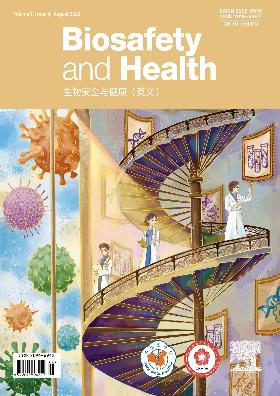
Biosafety and Health
Volume 07 · Issue 04 · 2025
Published: August 25, 2025
Biosaf Health
Review Article
Open Access
Biosafety concept: Origins, Evolution, and ProspectsWanying Gao, Zongzhen Wu, Kunlan Zuo, Qiangyu Xiang, Xiaoya Chen, Lu Zhang, Huan Liu
Biosafety and HealthVol.07,No.042025
DOI: 10.1016/j.bsheal.2025.07.003
Abstract
Biosafety is essential to ensuring the safe and effective conduct of biological research by minimizing risks associated with laboratory work and biological materials. This paper traces the historical and conceptual development of biosafety, from its origins in pathogen containment to its expansion into broader domains. In the modern context, biosafety also involves the regulation of genetically modified organisms and the strengthening of laboratory oversight mechanisms. Biosafety and biosecurity are closely related in origin. Biosafety focuses on biological risks within laboratory environments, while biosecurity addresses biological risks associated with non-laboratory environments. The article summarizes the development of biosafety, extracting the evolution of its conceptual framework from a historical perspective, condenses and compares its scientific characteristics with those of biosecurity, and applies the methodology of science history to define its conceptual framework.
Short Report
Open Access
Microbiota of critical areas prior to reopening in an oncology center: Potential uncommon nosocomial pathogens for vulnerable populationsFreddy Villanueva-Cotrina, Fiorella Quiroz, Kathya L. Mimbela, Katia Quispe
Biosafety and HealthVol.07,No.042025
DOI: 10.1016/j.bsheal.2025.07.002
Abstract
Healthcare-associated infections are linked with the contamination of inanimate surfaces and the air in occupied hospital areas by recognized pathogens. However, there is limited information about the presence of these microorganisms or other potential pathogens in critical areas prior to their clinical operation. Here, we determined the microbial community in critical areas prior to their validation for hospital care and reviewed the background for the potential pathogenic role of this microbiota for populations susceptible to opportunistic infections. We evaluated environmental samples from operating theatres (OTs) and bone marrow transplant rooms (BMTRs) at the Peruvian National Cancer Center. A total of 164 samples (58 air samples and 106 surface samples) were collected for bacterial and fungal culture. In the OTs, the air conditioning sample yielded the highest microbial isolation from air, with a predominance of the genera Bacillus (5/12 isolates; 41.7%) and Aspergillus (5/8 isolates; 62.5%), including Nigri (2/5) and Flavi (2/5) sections and Aspergillus sp. (1/5). Meanwhile, the surface sample with the highest bacterial isolation came from the shelf in the stock area, where there was a predominance of non-glucose-fermenting Gram-negative bacilli (NF-GNB) (8/15 isolates; 53.3%), including the genera Pseudomonas (4/8), Acinetobacter (2/8) and Stenotrophomonas (2/8). In BMTRs, the only microorganisms isolated from the air were coagulase-negative Staphylococcus species and Penicillium sp. In conclusion, the microbial community composition of the critical areas prior to their reopening was consistent with their unoccupied status, consisting of nosocomial saprophytic microorganisms. Furthermore, the predominant species of the basal microbiota included uncommon hospital pathogens for people susceptible to opportunistic infections, such as cancer patients.
Open Access
Development of an identity test for COVID-19 mRNA vaccines using SARS-CoV-2 NAT standardMiran Jo, Eunjo Lee, Ho Jung Oh, Jin Tae Hong, Kyung Hee Sohn
Biosafety and HealthVol.07,No.042025
DOI: 10.1016/j.bsheal.2025.07.007
Abstract
Despite the development of messenger ribonucleic acid (mRNA) vaccines for the infectious novel coronavirus 2 (SARS-CoV-2), further research on test methods is required to ensure their quality as well as rapid and effective approval for release to the market. During the current national lot release testing, identity tests cannot be conducted on other products using primers, probes, and in-house reference materials provided by the manufacturer and specific to one vaccine, because their sequences do not match. When key reagents and reference materials are dependent on the manufacturer in this way, difficulties in national lot release approval—which serves as an additional step for the government to verify product quality—arise if the manufacturer does not provide them. In this study, we aimed to develop a quantitative polymerase chain reaction (qPCR) assay by using commercially available nucleic acid amplification test (NAT) reference material and a dye instead of a probe along with primers that were newly designed in this study. It can be applied to both vaccines. This study suggests a test method that can be applied when the in-house reference standard for the identity test, a major step to confirm the quality of vaccines, is not secured.
Original Research
Open Access
A metagenomic approach for microbial risk assessment and source attribution in high-risk ports of entry environmentsXiaozhou He, Ran Zhang, Jie Dong, Wei Zhen, Li Zhu, Junkai Ren, Xuejun Ma, Feng Wang, Shuang Zhang, Ke Xu, et al.
Biosafety and HealthVol.07,No.042025
DOI: 10.1016/j.bsheal.2025.07.001
Abstract
The epidemiological characteristics of emerging infectious disease outbreaks in recent years have underscored the critical importance of controlling imported infectious diseases. In this study, we implemented dynamic tracking of microbial invasions by monitoring environmental microbes at the customs and ports. From July to September 2024, a total of 126 environmental samples were collected from three ports of entry in Shenzhen, China. Metagenomic analysis detected 55 non-viral microbial communities and 12 viral taxa. Among these, 26.8 % of the bacteria, 100 % of the fungi, 71.4 % of the protists, and none of the archaea exhibited potential pathogenic properties. Viruses were the most prevalent, including bacteriophages (100 %), unclassified viruses (96.8 %), giant viruses (27.8 %), fungal viruses (4.8 %), and vertebrate viruses (1.6 %). No statistical differences were observed in viral distribution across areas (χ2 = 18.70, P = 0.541), sites (χ2 = 14.02, P = 0.597), or ports of entry (χ2 = 10.27, P = 0.247). However, viral distribution varied significantly across three sampling months (χ2 = 21.06, P = 0.002), with a higher proportion of giant viruses detected in July. Thirty-nine and forty microorganisms were identified across the six areas and five sites, respectively, with relatively few area/site-specific microorganisms. Four distinct disinfection level zones were categorized: relatively safe zone, less safe zone, general disinfection zone and key disinfection zone. Two strains of viruses with potential pathogenicity were identified: pigeon circovirus and Influenza A virus (H4N2). This study established a metagenomics-based surveillance framework for microbial risk assessment in high-risk port environments and proposed a four-tier disinfection strategy to prioritize high-contact zones. Our findings highlighted environmental metagenomics as a critical complement to traveler screening and provided early warning signals for the prevention and control of imported infectious diseases.
Open Access
Random forest-based predictor selection and pneumonia risk probability assessment in acute respiratory infections: A cross-sectional study in Chongqing, China, 2023-2024Yunshao Xu, Yuping Duan, Jule Yang, Mingyue Jiang, Yanxia Sun, Yanlin Cao, Li Qi, Zeni Wu, Luzhao Feng
Biosafety and HealthVol.07,No.042025
DOI: 10.1016/j.bsheal.2025.07.004
Abstract
Progression of acute respiratory infection (ARI) to pneumonia increases severity and healthcare burden. Limited evidence exists on using machine learning to identify predictors from demographics, clinical, and pathogen detection data. This study aimed to identify pneumonia predictors in ARI patients using machine learning methods. This observational study was conducted in Chongqing, China, from September 2023 to April 2024. Outpatients and inpatients with ARI were recruited weekly. A random forest algorithm was used for predictor selection, followed by a logistic regression-based nomogram to analyze the probability of pneumonia. Among the 1,638 patients with ARI, those with pneumonia had higher rates of influenza A virus (IFV-A) (49.2 % vs. 39.6 %), influenza B virus (26.3 % vs. 18.6 %), and respiratory syncytial virus (6.1 % vs. 1.9 %) infection than those without pneumonia. In the subgroup of 79 patients with comprehensive blood tests, pneumonia was positively associated with hemoglobin (130.00 g/L vs. 124.00 g/L), blood urea nitrogen (5.73 mmol/L vs. 4.85 mmol/L), C-reactive protein (36.10 mg/L vs. 25.25 mg/L), procalcitonin (0.11 μg/L vs. 0.07 μg/L), and D-dimer (0.95 μg/L vs. 0.80 μg/L) levels, whereas pneumonia was inversely associated with neutrophils (4.20 × 10⁹/L vs. 4.76 × 10⁹/L), aspartate aminotransferase (22.50 U/L vs. 24.00 U/L), and uric acid (280.90 μmol/L vs. 330.00 μmol/L) levels. Elevated D-dimer levels (adjusted odds ratio [aOR] = 1.002, 95 % confidence interval [CI]: 1.001-1.004) and IFV-A infection (aOR = 9.308, 95 % CI: 2.433-35.606) were significantly associated with increased pneumonia probability. In future clinical practice, particular attention should be given to ARI patients with elevated D-dimer levels and IFV-A infections.
Open Access
Inactivation of BSL-2 and BSL-3 human pathogens using FATHHOME’s Trinion Disinfector: A rapid and eco-friendly ozone-based dry disinfection approachKabita Adhikari, Elizabeth Zhou, Majid Khan, Shubhasish Goswami, Amir Khazaieli, Blake A. Simmons, Deepika Awasthi, Subhash C. Verma
Biosafety and HealthVol.07,No.042025
DOI: 10.1016/j.bsheal.2025.07.006
Abstract
The role of personal protective equipment (PPE) in protecting against exposure to infectious agents and toxic chemicals is well-established. However, the global surge in PPE demand during the pandemic exposed challenges, including shortages and environmental impacts from disposable waste. Developing effective, scalable, and sustainable decontamination methods for the reuse of PPE is essential. Ozone has emerged as a promising, eco-friendly disinfectant due to its strong oxidative properties, rapid action, and residue-free breakdown into oxygen. This study evaluates the effectiveness of the FATHHOME Trinion Disinfector, an innovative ozone-based dry sterilization device, for inactivating pathogens on PPE materials, such as not resistant to oil 95 (N95) masks and face shields. The device’s bactericidal performance was tested against Escherichia coli, Pseudomonas aeruginosa, Staphylococcus aureus, Salmonella typhimurium, Enterococcus durans, Enterococcus faecalis, and Saccharomyces cerevisiae, achieving a 1- to 2-log reduction in these bacterial and fungal pathogens. A 30-minute ozone exposure cycle was found to attain maximum sterilization efficiency. We also demonstrated the disinfector’s efficacy against viral pathogens, severe acute respiratory syndrome coronavirus 2 (SARS-CoV-2), adeno-associated virus (AAV), herpes simplex virus type 1 (HSV-1), and hepatitis B virus (HBV) on PPE surfaces. SARS-CoV-2 contamination on face shields and N95 masks decreased by 99.9 %, and AAV infectivity was nearly eliminated. Similar reductions were observed for HSV-1 and HBV. Overall, the findings confirm that ozone-based disinfection offers a rapid, scalable, and sustainable method for decontaminating PPE. These results support the establishment of standardized ozone disinfection protocols to enhance infection control, address PPE shortages, and minimize environmental waste.
Open Access
DeepHVI: A multimodal deep learning framework for predicting human-virus protein-protein interactions using protein language modelsXindi Wang, Junyu Luo, Xiyang Cai, Ruibin Liu, Yixue Li, Chitin Hon
Biosafety and HealthVol.07,No.042025
DOI: 10.1016/j.bsheal.2025.07.005
Abstract
Understanding human-virus protein-protein interactions is critical for studying molecular mechanisms driving viral infection, immune evasion, and propagation, thereby informing strategies for public health. Here, we introduce a novel multimodal deep learning framework that integrates high-confidence experimental datasets to systematically predict putative interactions between human and viral proteins. Our approach incorporates two complementary tasks: binary classification for interaction prediction and conditional sequence generation to identify interacting protein partners. By leveraging protein language models and multimodal fusion, the framework demonstrates improved accuracy in identifying biologically relevant interactions. For empirical validation, we applied this method to predict severe acute respiratory syndrome coronavirus 2 (SARS-CoV-2)-human interactions, identifying candidate proteins absent from training data, several of which were corroborated by independent studies. These predictions offer critical insights into potential therapeutic targets, facilitating the design of antiviral drugs and vaccines. By enabling rapid, cost-effective discovery pipelines, our study contributes to pandemic preparedness and public health interventions, underscoring its value in combating emerging infectious diseases.
CURRENT ISSUE
Download Cover(PDF) Download TOC(PDF)
